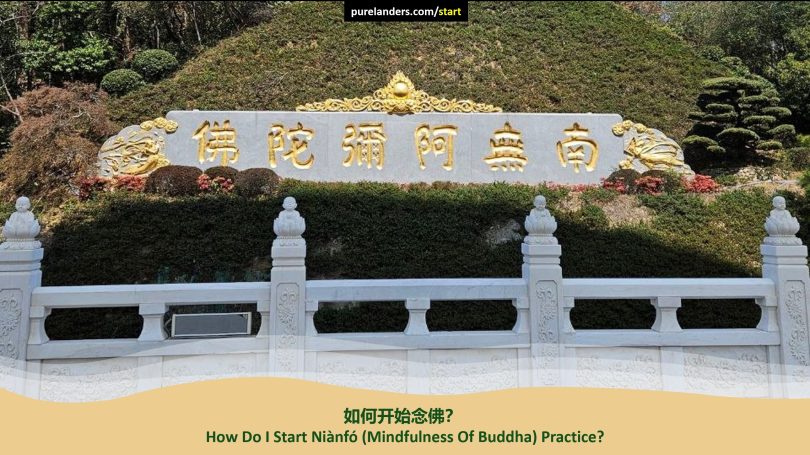
如何开始念佛?
How Do I Start Niànfó (Mindfulness Of Buddha) Practice?
Question: How do I begin my Niànfó (念佛) practice (of being mindful of the name of Amitā[bha] Buddha – ‘Āmítuófó’ [阿弥陀佛])?
Answer: It is best to attend a course personally to learn systematically and comprehensively, such as through the next run of this course: Understanding Āmítuófó Via The Amitābha Sūtra: http://thedailyenlightenment.com/?s=via+sutra+run which uses this book for reference (Amitābha Sūtra): http://thedailyenlightenment.com/2012/10/new-amitabha-book.
Nevertheless, here are some brief tips for beginners on how to practise (seated) Niànfó daily. May they also be reminders for non-beginners. (Note that these tips equally apply to practice of mindfulness of any other Buddha’s or Bodhisattva’s name and mantra too.)
When To Practise
[i] At least twice a day for a start: With 10 recitations each in morning and evening – longer once if possible – with prostrating, repentance and sharing of merits each time, or at the end of the day.
[ii] Increase duration: From 5 minutes, to 10, 15, 20, 25, 30, 60 …
[iii] Nianfo is Main Practice (正行): Other Supportive Practices (助性), which should take less time and efforts, are optional, e.g. sutra, mantra-chanting, other meditations…
[iv] Increase sessions: Including just before 3 meals = 5 times… or more, e.g. waiting and walking times… for overflow and permeating effect in everyday life.
How To Practise
[1] Three Provisions: As Niànfó should be with the Three Provisions (of Faith, Aspiration and Practice) (信愿行三资粮), their definitions should be understood first: https://purelanders.com/3p.
Even if one is not practising directly for birth in Pure Land yet due to lack of understanding, and prefers to practise for other general purposes first (such as wanting blessings), one should still be open to learning more later.
[2] Reverence And Repentance: Prostrate sincerely thrice before Āmítuófó’s image to express reverent refuge. (The image at https://purelanders.com/mp3 can be used.) Chant the ‘Verse For Repentance’ sincerely to settle the mind.
忏悔文
往昔所造诸恶业,
皆由无始贪瞋痴,
从身语意之所生,
今对佛前求忏悔。Verse For Repentance
Of all my past created evil karmas, all by beginningless greed, anger and delusion, from my body, speech and mind as arisen, now before the Buddha I seek repentance.
[3] Physical Posture: Sit still upright in the Lotus (or Half-Lotus or Burmese) Posture, with one-third of the buttocks on a meditation cushion for stability. (If not familiar with these, sit cross-legged the common way on somewhere firm with some cushion support.) Or on chair with feet planted firmly on the ground. Straighten the back but do not strain anywhere (such as the shoulders). Be upright but not uptight; relaxed but not lax. (See https://purelanders.com/2023/05/25/burmese-half-lotus-full-lotus-chair-postures for pictures.)
Place your hands in the Samādhi Mudra (定印) (concentration posture), palm down on each knee, or with palms joined together in reverence. Half-close eyes (to let in some light to prevent drowsiness). Do not look anywhere in particular, by putting your eyes in their natural positions.
[4] Mental Posture: Be mentally relaxed but alert. Where there is tension at any part of the body, or stray thoughts, resolve to let them go by not bothering about them. Do not be purposely mindful of any physical feeling or thought. Let go of all sensations of the environment by dissolving attention on them.
[5] Centering: Stay centred in the present moment. Let go thoughts of the past and future. Breathe normally, as you watch your breathing calmly and clearly. If it is too fast, take one deep breath before normalising.
[6] Actual Niànfó: Using the ‘Āmítuófó’ track at https://purelanders.com/mp3 as a guide (unless not needed), chant along as sincerely as you can, with each word clearly enough for yourself to clearly hear, to ensure your chanting is proper and mindful, without straying away.
It is natural for beginners to have stray thoughts, including aches and pains, but simply swiftly return to Amítuófó’s name each time they arise, and they will lessen. Abide peacefully only upon Āmítuófó’s name (安住佛号) and nothing else. (The quicker this is done, the faster will distractions fade away. Remember the admonition below.)

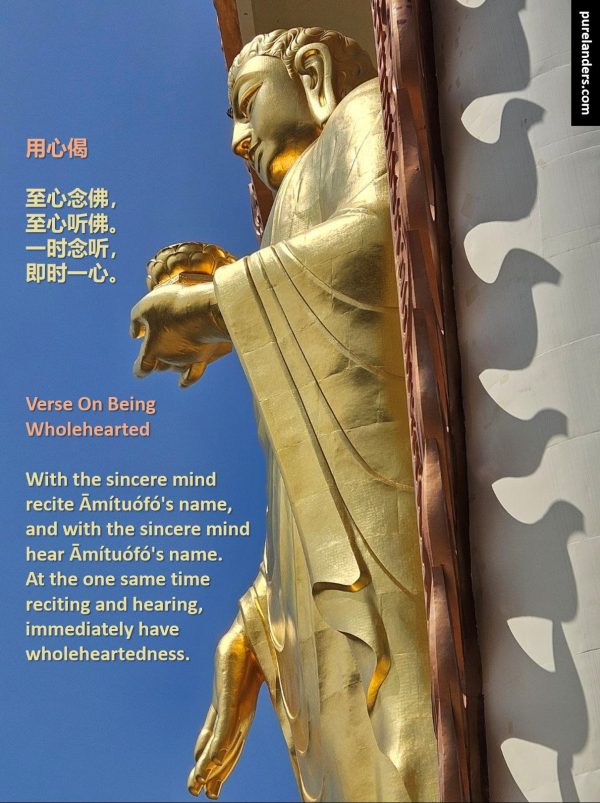
[7] Chanting Aloud: For beginners, it is best to chant aloud (i.e. not loudly but loud enough for yourself to hear) to increase mindfulness. If inconvenient (or tiring), chant silently in your mind, while also listening to your chanting in your mind. As only the sense faculties of thought and hearing should be used, do not think of, or visualise anything else. Maintain and increase focus on Āmítuófó’s name with continual mindfulness. Wholehearted sincerity is key for fruitful practice.
[8] Dedication Of Meritorious Virtues: Chant the ‘Verse For Dedication Of Merits’. (The full meaning of the verse is shared in the course above.) After which, merits can be dedicated to specific groups (such as family) or individuals for their well-being using your own words.
(As it is a natural universal law that only one-seventh of merits created can be dedicated to others, it is ideal that those we wish well practise Niànfó personally too. Wisdom [智慧] however, cannot be dedicated, and can only be learnt for realisation. However, merits can be dedicated for decreasing afflictions [烦恼] and increasing opportunities to become wiser.)
回向文
愿以此功德,庄严佛净土,
上报四重恩,下济三途苦。
若有见闻者,悉发菩提心,
尽此一报身,同生极乐国。Verse For Dedication Of Merits
May these meritorious virtues, adorn the Buddha’s Pure Land, repay the four weighty sources of kindness [which are our parents, the Triple Gem (Buddhas, Dharma, Saṅgha), society (country) and all sentient beings] above, and relieve suffering of the three paths [of hell-beings, hungry ghosts and animals] below. If there are those who see or hear this, may all give rise to the Bodhi Mind [Bodhicitta, which is the aspiration to attain Buddhahood while guiding all sentient beings to the same goal], and at the end of this one retribution body [that is karmically subject to suffering], be born in the [Pure] Land of Ultimate Bliss together.
[9] Progress Factors: With regular (daily) and diligent practice (of 5 to 15 minutes, or more), and as much as possible in spare time, or while doing tasks that do not require much thinking, there will be progress factors experienced, of increase in calmness, clarity and blissfulness through connecting your Buddha-nature (佛性) (potential to become Buddha) to Āmítuófó’s blessings, which help to further awaken it.
Niànfó is best practised not when very tired, but when reasonably wakeful, so as to not fall asleep or lose concentration. For example, it can be done after freshening up at night, after settling the day’s work and bathing, when not too late. The more diligent should have a Niànfó session in the morning too.
(Using of prayer beads as a counter to measure committed quotas of chants is distracting, while a watch or phone timer can be used to countdown the committed time, with which the estimated number of chants can be known too.)
[10] Group Cultivation (Practice): It is very beneficial to join a proper Niànfó practice group for more motivation for practice, clarification of doubts, exchange of pointers and experiences. One such group is the Pureland Practice Fellowship, which is for all past participants of courses such as that listed above. Group practice not only provides spiritual friendship for support, there are also more merits created with collective practice for everyone’s benefit. Retreats are important too, for deepening practice.
相关教理
Related Teachings:
静坐念佛之散盘、单盘、双盘与椅姿
Burmese, Half Lotus, Full Lotus And Chair Postures For Seated Mindfulness Of Buddha
https://purelanders.com/2023/05/25/burmese-half-lotus-full-lotus-chair-postures
念佛提醒激励文
Motivational Reminders
(Niànfó Resolutions)
https://purelanders.com/2025/12/01/motivational-reminders-nianfo-resolutions
念南无阿弥陀佛和阿弥陀佛有何分别?
How Does Reciting Námó Āmítuófó Differ From Reciting Āmítuófó?
https://purelanders.com/2023/04/06/how-does-reciting-namo-amituofo-differ-from-reciting-amituofo
净行会念佛闭关感言
Reviews Of PPF Nianfo Retreats
https://purelanders.com/2018/01/10/pureland-practice-fellowship-retreat-reviews
十大念佛共修挑战
[4] Top Ten Niànfó Group Cultivation Challenges
https://purelanders.com/2022/11/02/top-ten-nianfo-group-cultivation-challenges
十大净行会三小时闭关念佛之优点
[46] Top Ten Advantages Of PPF Three-Hour Niànfó Retreats
十条静修须知
Ten Retreat Dos And Don’ts
https://purelanders.com/2025/12/01/46-top-ten-advantages-of-ppf-three-hour-nianfo-retreats