关于临终时使用止痛药的十大误解
[53] Top Ten Misconceptions On Usage Of Painkillers When Dying
Question: Is it true that when approaching life’s end (临终), Pure Land practitioners (净土行者) must not use painkillers (止痛药), such as morphine (吗啡), which might cause loss of Right Mindfulness (正念)?
Answer: This can be answered with ten misconceptions and their corrections.
Misconception [1]: It is always wrong to use painkillers when dying.
Correction [1]: Whether it is skilful to use them or not depends on — [i] why they are used, [ii] how much are used, and [iii] what is being done when they are used. If used, they should be sparingly used, to prevent much confusion (or hallucination) and drowsiness (or unconsciousness) ‘beyond’ control.
Misconception [2]: Some only try to accumulate good karmas (善业), without much Right Mindfulness (正念) in everyday life. They are also without Niànfó (念佛) Practice with mindfulness of Āmítuófó’s (阿弥陀佛) name with Faith and Aspiration (信愿持名) on their deathbed, especially if confused due to painkillers.
Correction [2]: Niànfó IS Right Mindfulness for Pure Land practitioners. This Practice should start now, in everyday life, to increase ease of Practice when departing, or when just departed. The Three Provisions (三资粮) of Faith, Aspiration and Practice (信愿行) should ideally be accumulated amply and unshakably, way before dying, so that they can be utilised then.
Misconception [3]: If good or evil karmas manifest on the deathbed, those with minds scattered and confused (散乱) due to painkillers will be without Right Mindfulness, and follow their karmas to be reborn (随业流转) elsewhere; not in Pure Land.
Correction [3]: With the Three Provisions well accumulated, even if at the last minute, their pure karmas (净业) can manifest in time with the Buddha’s blessings to prevent confusion. However, as there might be some uncertainty, and to give confidence, there should be offering of guidance (开示) and support-chanting (助念) to remind and motivate.
Misconception [4]: When approaching life’s end (临终), there must be Right Mindfulness distinct and clear (正念分明) with the Sixth Consciousness (第六识) to reach Pure Land. When with painkillers, the Sixth Consciousness will be scattered and confused, without Right Mindfulness then.
Correction [4]: Ideally, the consciousness departs before physical death, with the departing of which, the body dies naturally then. However, many do reach Pure Land after physical death, which is why there should be post-death support-chanting (往生后助念). After death, the Sixth Consciousness (with the first five consciousnesses and the Seventh) will collapse into the Eighth Consciousness (第八识), which WILL be without confusion due to painkillers as the consciousness will no longer be functioning through the drugged body. This consciousness can still have wholehearted mindfulness of Āmítuófó’s name for reaching his Pure Land.
Misconception [5]: As the Sixth Consciousness is needed to guide the fruition of karmas when approaching life’s end to reach Pure Land, it must remain clear.
Correction [5]: As in Correction [4], the Eighth Consciousness can have the exact same function of creating pure karmas and directing good karmas.
Misconception [6]: As rebirth occurs at life’s end (命终), the moment of death (死亡时刻) is the moment of rebirth (往生时刻).
Correction [6]: The moment of death SELDOM coincides exactly with the moment of rebirth, with the latter usually occurring later. This is why there should be extended offering of guidance and support-chanting after death, for eight hours or more. In fact, this should go on for 49 days after death, which is the duration the average person might stay in the bardo or intermediate (中阴) state before rebirth, as continually as possible, especially if there is no clear auspicious sign (瑞相) of reaching Pure Land yet.
Misconception [7]: No matter how much pain the dying has, there should just be Faith that the Āmítuófó can save one, with Aspiration to reach his Pure Land, focusing on mindfulness of his name, without using painkillers.
Correction [7]: This is valid only for the very proficient and willing practitioners. For those with [i] great pain and [ii] low pain threshold, refusing to offer painkillers can prove cruel for these ‘tortured’ patients, who might give rise to four kinds of fears — of the [i] pain present, the [ii] pain going on indefinitely, [iii] death coming, and [iv] how they will be reborn because of the pain. They might thus give rise to [i] confusion on why the pain is not relieved, and [ii] anger for the pain not being relieved. These are wrong subjects of mindfulness, that distract from mindfulness of Āmítuófó’s name. If reborn with these negative emotions, there can be fall into the lower realms.
Misconception [8]: The dying need to overcome pain and other distractions with mindfulness of Āmítuófó’s name all by themselves.
Correction [8]: With painkillers used or not, this is not so, as there should be support-chanters reminding and encouraging with their recitation aloud. Once there is connection to Āmítuófó, one is definitely not alone, but in the pure company of Āmítuófó and his assembly.
As taught by Śākyamuni Buddha (释迦牟尼佛) in the Amitābha Sūtra《阿弥陀经》, ‘[I]f there are good men and good women, who hear this spoken about Amitā[bha] Buddha, firmly [i.e. faithfully] upholding his name [i.e. Āmítuófó: 阿弥陀佛]… wholeheartedly without being scattered, when these persons approach life’s end, Amitā[bha] Buddha, with many in his noble assembly, will appear before them. When these persons’ [lives are] end[ing], their minds will not be inverted, and they will immediately attain rebirth in Amitā[bha] Buddha’s Land Of Ultimate Bliss.’ (若有善男子、善女人,闻说阿弥陀佛,执持名号… 一心不乱,其人临命终时,阿弥陀佛,与诸圣众,现在其前。是人终时,心不颠倒,即得往生阿弥陀佛极乐国土。)
Thus, when there is wholehearted (i.e. faithful) mindfulness of Buddha, this will lead to the mind not being scattered naturally, Āmítuófó will appear to offer blessings. The last line can be read as [i] ‘When these persons’ lives are ending, their minds will not be inverted, and they will immediately attain rebirth in Amitā[bha] Buddha’s Land Of Ultimate Bliss’, or [ii] ‘When these persons’ lives end, their minds will not be inverted, and they will immediately attain rebirth in Amitā[bha] Buddha’s Land Of Ultimate Bliss.’ Both meanings are equally right.
[i] This means that if there is wholehearted mindfulness of Āmítuófó’s name before physical death, with his blessings, their previously inverted minds (perhaps with some attachment to life, aversion to death, and delusion on what is happening) will be uprighted. This implies that the wholehearted mind before receiving the blessings need not be very upright with great mindfulness (in terms of concentration and clarity).
[ii] This means that if there is wholehearted mindfulness of Āmítuófó’s name after physical death, with his blessings, their previously inverted minds (perhaps with some attachment to life, aversion to death, and delusion on what is happening) will be uprighted. This implies that the wholehearted mind before receiving the blessings need not be very upright with great mindfulness (in terms of concentration and clarity).
‘Misconception’ [9]: Why are the above misconceptions ‘so wrong’?
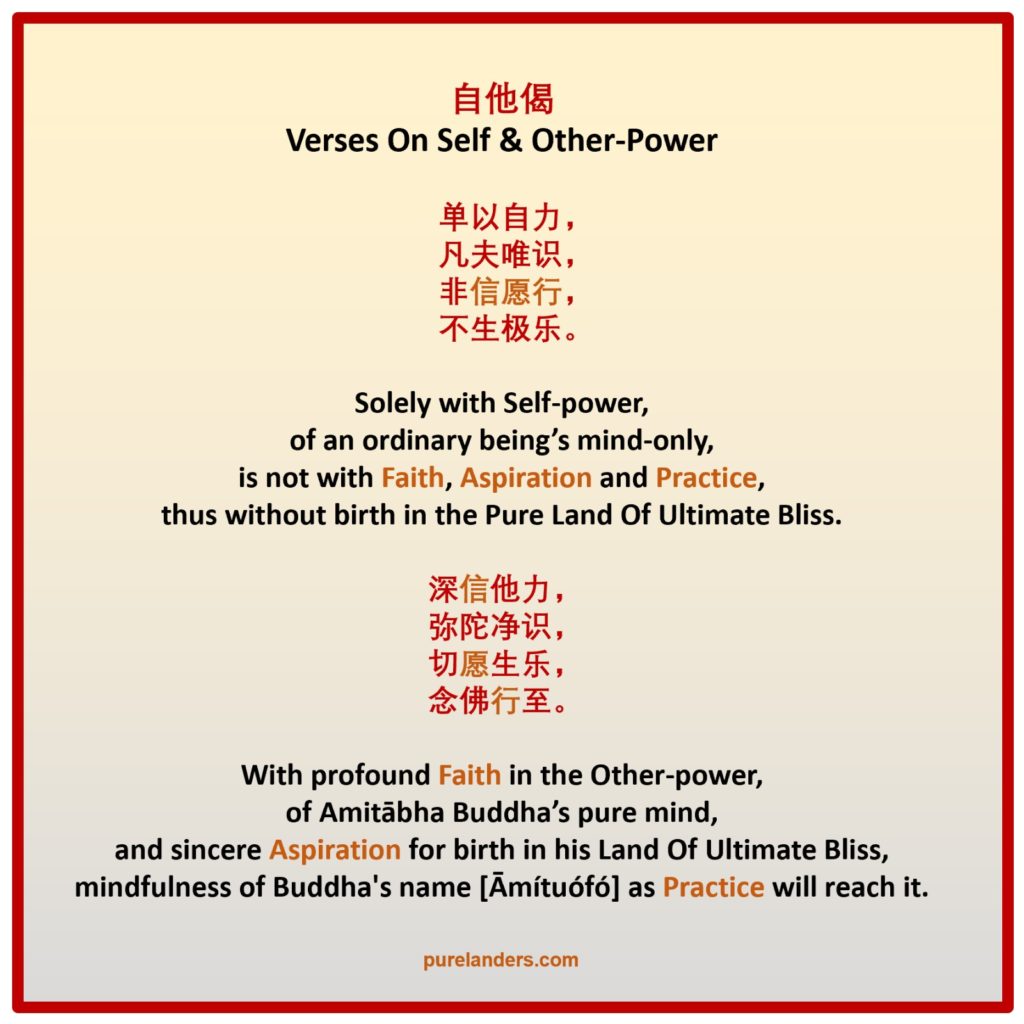
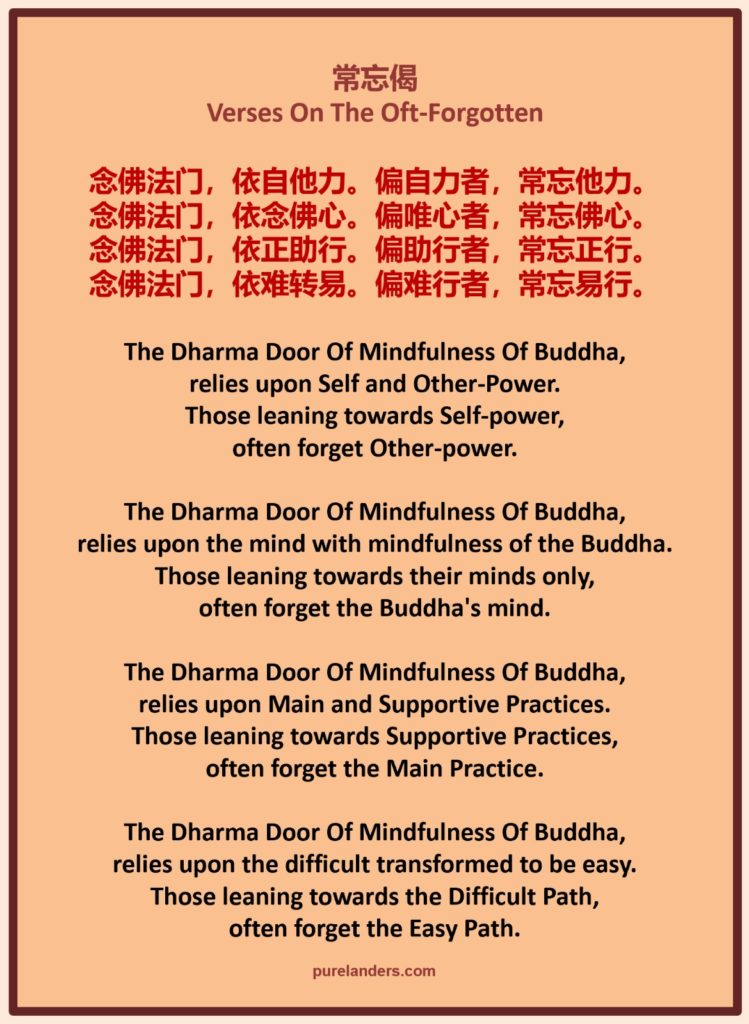
Correction [9]: They arise from some mind-only (唯识) perspectives, which are incomplete as they do not consider the dynamics of the mind (consciousness) after death, when unencumbered by the body and drugs. They also do not consider the dynamics of very limited self-power (自力) when connected to the Buddha’s very powerful other-power (他力), with the latter making a world of difference in uprighting and uplifting the mind.
‘Misconception’ [10]: Are the above corrections complete? Are there more considerations?
Correction [10]: Do see [6] Painkillers at https://purelanders.com/2015/12/30/important-guidelines-1-before-dying-pure-land-passport-section-4a, along with the other guidelines there, and the below verses.
相关教理
Related Teachings:
净土教理十大系列
Pure Land Teachings’ Top Ten Series
https://purelanders.com/shida