斋日与月
Purification Days And Months
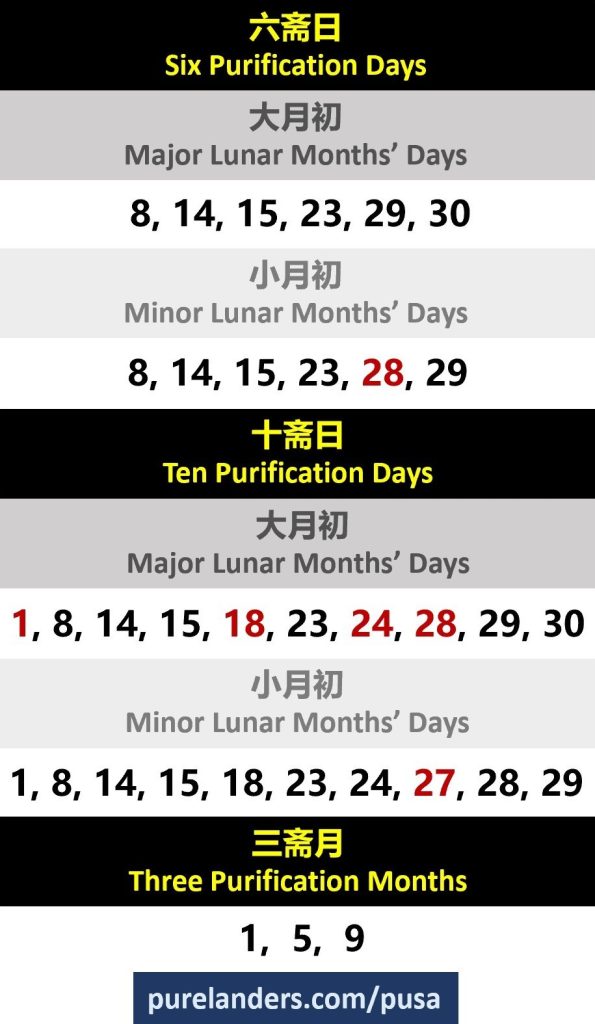
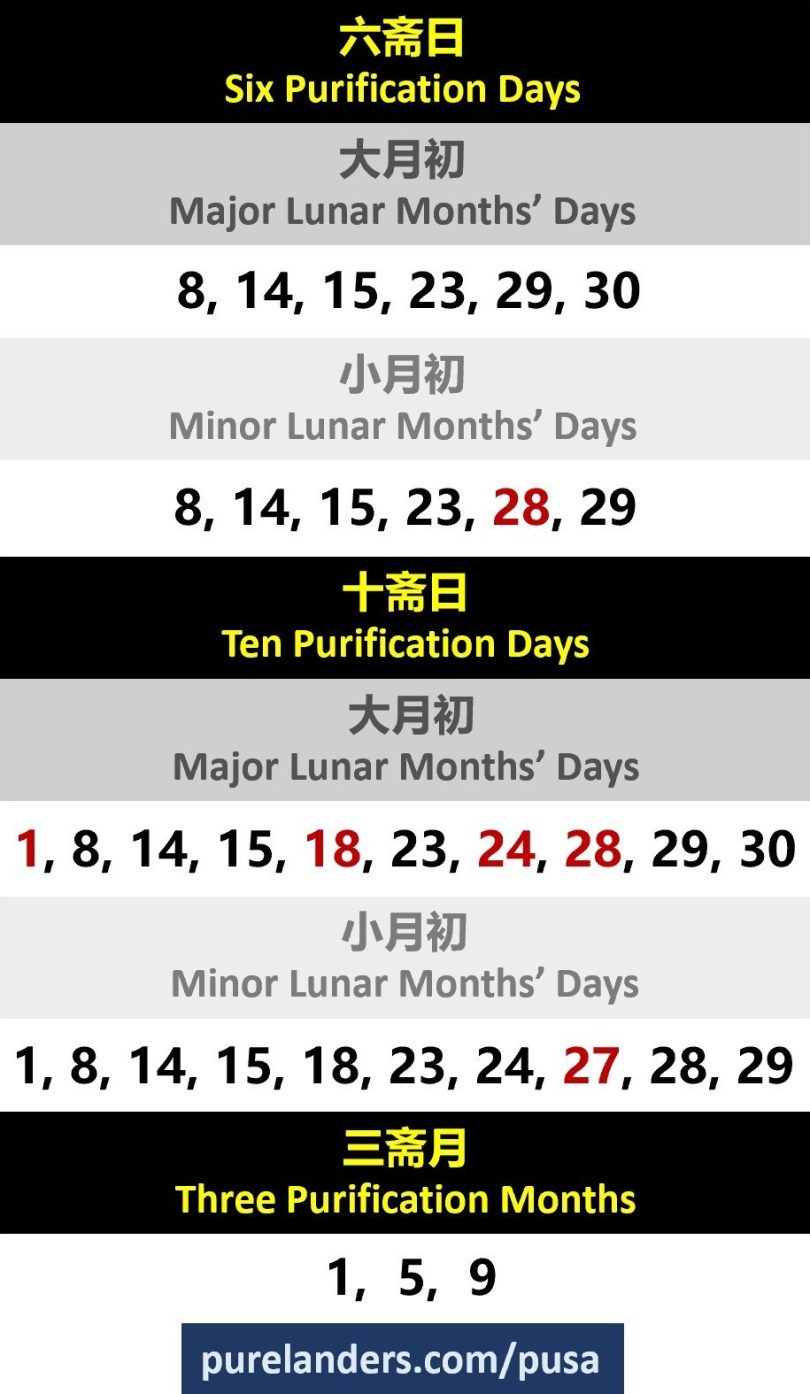
六斋日
Six Purification Days
大月初
Major Lunar Months’ Days
8, 14, 15, 23, 29, 30
小月初
Minor Lunar Months’ Days
8, 14, 15, 23, 28, 29
十斋日
Ten Purification Days
大月初
Major Lunar Months’ Days
1, 8, 14, 15, 18, 23, 24, 28, 29, 30
小月初
Minor Lunar Months’ Days
1, 8, 14, 15, 18, 23, 24, 27, 28, 29
三斋月
Three Purification Months
1, 5, 9
关于斋日与月
About Purification Days And Months
一日持斋,得六十万世余粮。
释迦牟尼佛
《佛说护净经》
On day’s upholding [of] purification [i.e. with the Eight Precepts], attains more [than] six hundred thousand lives’ provisions.
Śākyamuni Buddha
[The] Sūtra [In Which The] Buddha Speaks [Of] Protecting Purity
The Six Purification Days (六斋日) are every lunar month’s 8th, 14th, 15th, 23rd, 29th and 30th days (or 28th day for minor months [小月] without the 30th day in major months [大月]). There are also the Three Purification Months (三斋月), which are the 1st, 5th and 9th lunar months.
There should be observation of the Eight Precepts (八戒) on the Six Purification Days (六斋日) and in the Three Purification Months (三斋月). As taught in the Upāsaka Precepts《优婆塞戒》, ‘On the Six Purification Days, and in the Three Purification Months, receive the Eight Precepts to uphold purification. Bodhisattvas at home should practise these practices.’ (六斋日、三斋月,受八戒持斋。在家菩萨应行此事。)
For the more diligent, the (extended) Ten Purification Days (十斋日) are every lunar month’s 1st, 8th, 14th, 15th, 18th, 23rd, 24th, 28th, 29th and 30th day (or 27th day for minor months without the 30th day).
The Purification Days at least should be observed fully, if the Purification Months are challenging due to worldly work, family and social obligations. However, as many of the Eight Precepts as possible can still be observed in these periods.
On these ‘days’, for one day and night (一日一夜), there are practices of eating as veg(etari)ans (吃素): https://thedailyenlightenment.com/veg, also observing the Eight Precepts (八戒): https://purelanders.com/2018/06/29/eight-precepts-ceremony of abstaining from:
(i) killing lives (不杀生),
(ii) stealing (不偷盗),
(iii) sexual conduct (不淫),
(iv) false speech (不妄语),
(v) drinking alcohol (i.e. consuming intoxicants) (不饮酒),
(vi) wearing perfumes, flowers and garlands, applying fragrant oils on the body (不着香花鬘,不香油涂身),
(vii) sitting and lying on high, broad and big (seats and) beds (不坐卧高广大床), singing, dancing, having entertainment, going to see or hear such (不歌舞倡伎,不往观听), and
(viii) untimely eating (不非时食) after noon.
The older and perhaps retired should have less, if any ‘excuses’, to not observe them, since they have more ‘freedom’, while the time left in their physical lives for living the spiritual life is running out. For those still working, there are perhaps three aspects more challenging to uphold:
(6) On the Sixth Precept about ‘abstaining from wearing perfumes, flowers and garlands, not applying fragrant oils on the body’ (不着香花鬘,不香油涂身), there should be trying to look presentable without or with minimum make-up, self-adornment and such (if ‘required’ for work).
(7) On the Seventh Precept which includes ’abstaining from singing, dancing, having entertainment, not going to see or hear such’ (不歌舞倡伎,不往观听), there can be mental blocking from entertainment in terms of sight and sound by ignoring them, perhaps with mindfulness of Buddha (念佛), and minimising of social activities (if not totally unavoidable).
(8) On the Eighth Precept about ‘abstaining from eating after noon’ (过午不食), if more energy is needed for work, there can be eating more at lunch, or just a little more later if needed, not too much to become indulging.
On the first (8th) and fourth (23rd) of the Six Purification Days, the Heavenly Emperor Śakra (天帝释) will order the Four Great Heavenly Kings (四大天王) to survey their four cardinal directions’ (i.e. East, South, West and East) four great continents (四大州), who will then send their ministers to observe humans’ good and evil done.
On the second (14th) and fifth (29th of major months or 28th of minor months) of the Six Purification Days, the Four Great Heavenly Kings will send their Princes to travel to their continents to observe humans’ good and evil done.
On the third (15th) and sixth (30th of major months or 29th of minor months) of the Six Purification Days, the Four Great Heavenly Kings will personally travel to their continents to observe (and record) humans’ good and evil done, (with them and other gods rejoicing for good done, bestowing blessings; worried and sad for evil done, descending with the inauspicious to admonish).
In the Three Purification Months, (1st, 5th and 9th), the Heavenly Emperor Śakra, with his great treasure mirror (大宝镜), will reflect upon the Southern Jambudvīpa Continent (南赡部洲), which is this part of the Sahā World (娑婆世界), to observe humans’ good and evil done. The Northern Vaiśravaṇa Heavenly King (北方毗沙门天王) will also patrol all four continents to do likewise.
(Whether the gods will definitely ‘reward the good and punish the evil’ or not, directly or indirectly, their observation reflects the truth that with all our good and evil karmas created and not created, everything is consequential.)
The Buddha used the above practices of the gods concerned about our moral welfare as a skilful means to further urge us to practise avoiding of evil and doing of good more diligently on these days and in these months, with the Eight Precepts, on top of existing (Five and/or Bodhisattva) Precepts already upheld every day. Ideally, this periodical and extended breaking of bad living habits will lead to overflowing of bettered habits beyond these purification days and months, thus furthering our spiritual purification.
相关教理
Related Teachings:
六斋日与三斋月时该怎么修?
What Should Be Practised On The Six Purification Days And In The Three Purification Months?
+
持八戒之意义
The Significance Of Upholding The Eight Precepts
+
如何持第六七八戒
How To Uphold The Sixth, Seventh And Eighth Precepts
https://thedailyenlightenment.com/2024/12/what-should-be-practised-on-the-six-purification-days-and-in-the-three-purification-months
菩萨戒子应当如何持与舍八戒
How Bodhisattva Preceptees Should Uphold (And Relinquish) The Eight Precepts
https://thedailyenlightenment.com/2024/11/how-bodhisattva-preceptees-should-uphold-and-relinquish-the-eight-precepts
相关经典
Related Sūtra:
《梵网经卢舍那佛说菩萨十重四十八轻戒》:十重波罗提木叉:十重禁戒
[2] Brahma Net Sūtra’s Rocana Buddha’s Spoken Bodhisattvas’ Ten Heavy And Forty-Eight Light Precepts: Ten Heavy Prātimokṣas: Ten Heavy Prohibitive Precepts
https://purelanders.com/2024/06/28/brahma-net-sutra-bodhisattva-precepts-text-ten-heavy-pratimok%e1%b9%a3a-precepts-ten-heavy-prohibitive-precepts
梵网经菩萨戒本: 四十八轻戒 (三)
[5] Brahma Net Sūtra’s Bodhisattva Precepts’ Text: Forty-Eight Light Precepts (Part 3)
https://purelanders.com/2024/07/24/brahma-net-sutras-bodhisattva-precepts-text-forty-eight-light-precepts-part-3