[24] 远公为什么结莲社念佛求生西方?修行情况如何?
[24] Why [Did] Venerable Huìyuǎn Form [The White] Lotus Society [For] Mindfulness [Of] Buddha [To] Seek Birth [In His] Western [Pure Land Of Ultimate Bliss]? What [Were Its] Circumstances [Of] Cultivating Practice?
◎ 迨至大教东来,远公大师秉承两土世尊旨意,遂以净土为宗。竭尽极能而发挥倡导。创建东林寺,与缁素一百二十三人,结莲社念佛,求生西方。命刘遗民作文勒石,以明所誓。三十余年之内,其入莲社而修净业,蒙接引而得往生者,则多难胜数也。
◎ [Summary]: Waiting until [the] great [Buddhist] teachings [to] East[ern China] came, [the] Venerable Great Master Yuǎn [i.e. Huìyuǎn: 慧远], carrying out [the] two lands’ Thus Come [Ones’] orders, [was] thereupon with [founding of the] Pure Land as [a] Tradition. Exhausting [the] utmost [of his] abilities, [he] then exerted [to] advocate [it]. Creating [and] establishing Dōnglín Monastery [东林寺], with monastics [and] laypersons, one hundred [and] twenty-three persons, [they] formed [the White] Lotus Society [白莲社] [for] mindfulness [of] Buddha, [to] seek birth [in his] Western [Pure Land Of Ultimate Bliss (极乐世界)]. [He] ordered Liú Yímín’s composed text [to be] engraved [on a] rock, with [it for] explaining that vowed. Within more than thirty years, those [who] entered [the] lotus society and cultivated pure karmas, [who] received [the Buddha’s] reception [and] guidance, and attained rebirth, then [became so] many, [that it was] difficult [to be] counted completely.
◎ 远公则迹不入俗,专志净土,澄心系念,三见圣相,而沉厚不言。临终又见阿弥陀佛身满虚空,观音、势至,左右侍立。对身边弟子说:「吾始居此,三睹圣相,今复再见,必生净土。」
◎ [Extension]: Venerable Yuǎn [was] then [with his] footprints not entering [the] worldly, [with] focused Aspiration [to reach] Pure Land. Quietening [his] mind [with] continual mindfulness, [he] thrice saw [the] Noble [Ones’] forms. Yet [he remained] down-to-earth [and] sincere, [and did] not speak [of this. When] approaching [life’s] end, [he] again saw Āmítuófó’s body filling [the] empty sky, [with] Contemplator [Of The World’s] Sounds [观世音] [and Great] Power Arrived [大势至] [Bodhisattvas (菩萨), on his] left [and] right standing by to attend. To [the] disciples [by his] side, [he] said, ‘[Since] I [have] started dwelling here, [I have] thrice seen [the] Noble [Ones’] forms. Now again seeing [them, I will] definitely [be] born [in the] Pure Land.’
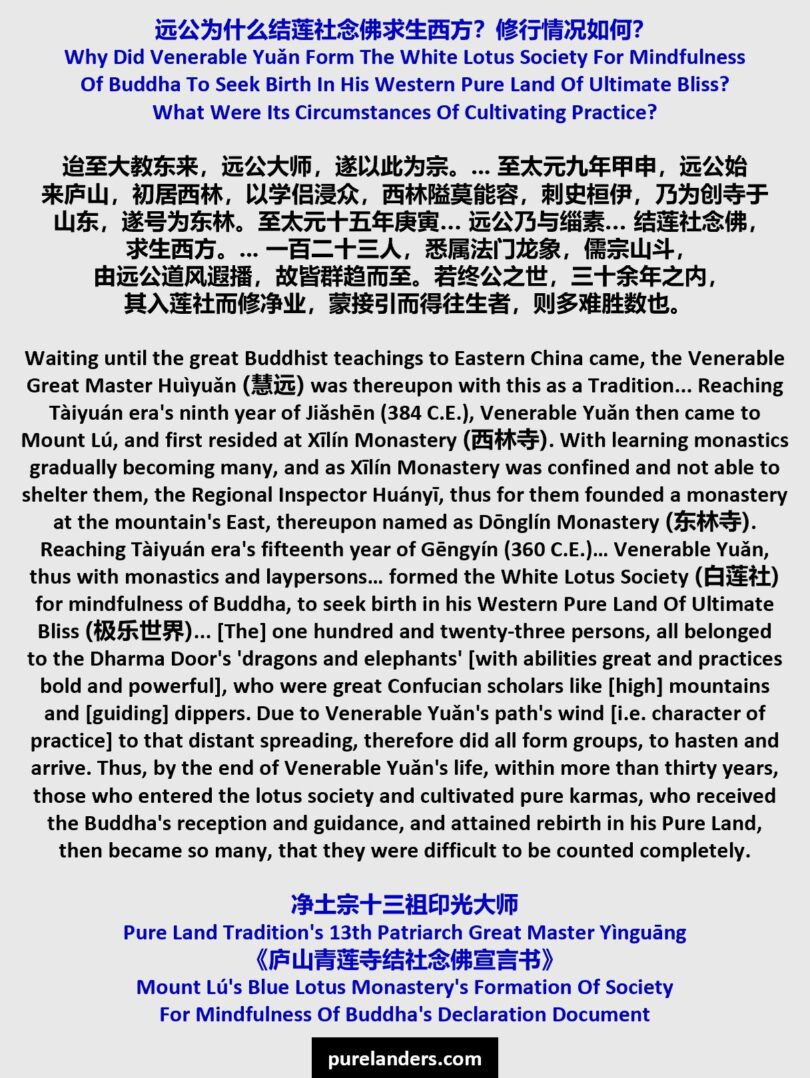
迨至大教东来,远公大师,遂以此为宗。
Waiting until [the] great [Buddhist] teachings [to] Eastern [China] came, [the] Venerable Great Master Yuǎn [i.e. Huìyuǎn: 慧远] [was] thereupon with this as [a] Tradition.
初与同学慧永,欲往罗浮,以为道安法师所留,永公遂先独往。
First with [his] classmate Huìyǒng, [they] desired [to] go [towards Mount] Luófú [罗浮山], as [it] was where Dharma Master Dào’ān stayed. Venerable Yǒng thereupon first went alone.
至浔阳,刺史陶范,景仰道风,乃创西林寺以居之,是为东晋孝武帝太元二年丁丑岁也。
Reaching Xúnyáng, [as the] Regional Inspector Táofàn admired [the] path’s wind [i.e. character of practice], [he] thus founded Xīlín [Monastery] [西林寺], with [it] for dwelling then. This was [in the] Eastern Jìn [Dynasty’s] Emperor Xiàowǔ’s Tàiyuán [era’s] second year’s Dīngchǒu year.
[Note 1: Dīngchǒu (丁丑) is the 14th year of the 60-year cycle, referring to 377 C.E. here.]
至太元九年甲申,远公始来庐山,初居西林,以学侣浸众,西林隘莫能容,刺史桓伊,乃为创寺于山东,遂号为东林。
Reaching Tàiyuán [era’s] ninth year [of] Jiǎshēn, Venerable Yuǎn then came [to] Mount Lú, [and] first resided [at] Xīlín [Monastery]. With learning monastics [求学僧侣] gradually [becoming] many, [and as] Xīlín [Monastery was] confined [and] not able [to] shelter [them, the] Regional Inspector Huányī, thus for [them] founded [a] monastery at [the] mountain’s East, thereupon named as Dōnglín [Monastery] [东林寺].
[Note 2: Jiǎshēn (甲申) is the 21st year of the 60-year cycle, referring to 384 C.E. here.]
至太元十五年庚寅,七月二十八日,远公乃与缁素一百二十三人,结莲社念佛,求生西方。
Reaching Tàiyuán [era’s] fifteenth year [of] Gēngyín, [on the] seventh month’s twenty-eighth day, Venerable Yuǎn, thus with monastics [and] laypersons, one hundred [and] twenty-three persons, formed [the White] Lotus Society [白莲社] [for] mindfulness [of] Buddha, [to] seek birth [in his] Western [Pure Land Of Ultimate Bliss (极乐世界)].
[Note 3: Gēngyín (庚寅) is the 27th year of the 60-year cycle, referring to 360 C.E. here.]
命刘遗民作文勒石,以明所誓。
[He] ordered Liú Yímín’s composed text [to be] engraved [on a] rock, with [it for] explaining that vowed.
而慧永法师,亦预其社。永公居西林,于峰顶别立茅室,时往禅思,至其室者,辄闻异香,因号香谷,则其人可思而知也。
Then, Dharma Master Huìyǒng, also participated in this society. [When] Venerable Yǒng resided [at] Xīlín [Monastery], on [its] peak, [he] separately established [a] thatched abode. When [he] goes [there for] meditative contemplation, those [who] approach this abode, [will] always smell extraordinary fragrance. Because [of this, it was] named [as the] Fragrant Valley. Thus, this person, can [with] contemplation, then [be] known.
当远公初结社时,即有一百二十三人,悉属法门龙象,儒宗山斗,由远公道风遐播,故皆群趋而至。
When Venerable Yuǎn first formed [the] society, immediately [participating] were one hundred [and] twenty-three persons, all belonging [to the] Dharma Door’s ‘dragons [and] elephants’, [who were] great Confucian scholars [like] mountains [and] dippers. Due [to] Venerable Yuǎn’s path’s wind [to that] distant spreading, therefore [did] all [form] groups, [to] hasten and arrive.
[Note 4: ‘Dragons and elephants’ (龙象) represent those with the greatest abilities (能力), and with bold and powerful (勇猛) practices.]
[Note 5: Great Confucian scholars (儒宗) are ‘儒学宗师’. Mountains and dippers (山斗) are Mount Tài (泰山), who represent those with virtues and knowledge (道德学问) high like the mountain (高如山), and the Northen Dipper (北斗), who are honoured (尊) like the Big Dipper (北斗七星: Northen Dipper’s seven stars), by the world’s people looked up to (世人仰望) as guiding lights.]
若终公之世,三十余年之内,其入莲社而修净业,蒙接引而得往生者,则多难胜数也。
Thus, [by the] end of Venerable [Yuǎn’s] life, within more than thirty years, those [who] entered [the] lotus society and cultivated pure karmas, [who] received [the Buddha’s] reception [and] guidance, and attained rebirth [in his Pure Land], then [became so] many, [that they were] difficult [to be] counted completely.
《庐山青莲寺结社念佛宣言书》
Mount Lú’s Blue Lotus Monastery’s Formation [Of] Society [For] Mindfulness [Of] Buddha’s Declaration Document
净土宗十三祖印光大师著
Written [By] Pure Land Tradition’s 13th Patriarch Great Master Yìnguāng
《印光法师答念佛600问》
Dharma Master Yìnguāng’s Answers [For] Mindfulness [Of] Buddha’s 600 Questions
传印法师鉴定
Evaluated [By] Dharma Master Chuányìn
Námó Āmítuófó : Translation and notes by Shen Shi’an