Previous Section | Contents | Next Section
原文:第二,大家换班念佛,以助净念者。
白话:第二,大家换班念佛,为帮助病人生起清净的念佛。
Second, everyone should take shifts to recite Āmítuófó’s name, so as to support pure mindfulness.
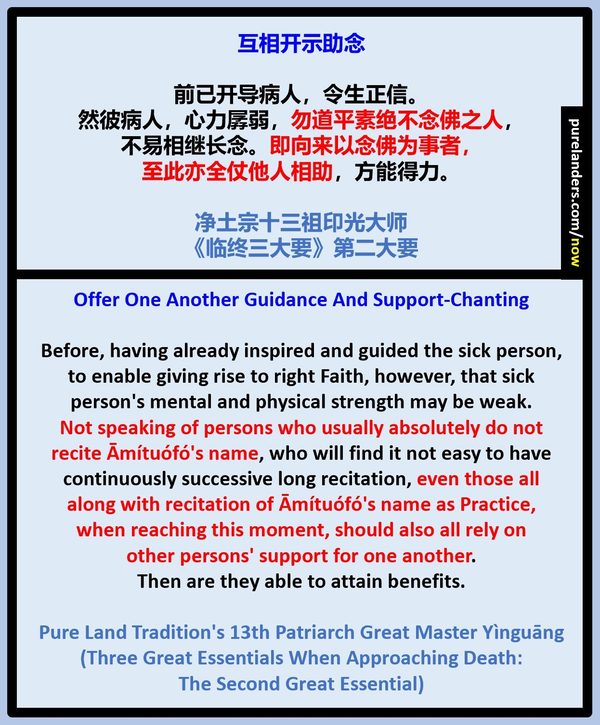
原文:前已开导病人,令生正信。然彼病人,心力孱弱,勿道平素绝不念佛之人,不易相继长念。即向来以念佛为事者,至此亦全仗他人相助,方能得力。
白话:前面已经开导了病人,令他生起了真正的信心。然而,这病人,心力虚弱。别说平时都不念佛的人,不容易相继长念,即使一向来修念佛的,此时也全仰仗别人的相助,才能得力。
Before, having already inspired and guided the sick person, to enable giving rise to right Faith, however, that sick person’s mental and physical strength may be weak. Not speaking of persons who usually absolutely do not recite Āmítuófó’s name, who will find it not easy to have continuously successive long recitation, even those all along with recitation of Āmítuófó’s name as Practice, when reaching this moment, should also all rely on other persons’ support for one another. Then are they able to attain benefits.
原文:以故家中眷属,同应发孝顺慈悲之心,为其助念佛号。
白话:所以家里的眷属,应该一起发孝顺与慈悲的心,为病人助念佛号。
Therefore, family members at home should together give rise to the mind of filial piety with loving-kindness and compassion, and for the sick person, practise support-chanting with Āmítuófó’s name.
原文:若病尚未至将终,当分班念。应分三班,每班限定几人。头班出声念,二三班默持。念一点钟,二班接念,头班、三班默持。
白话:如果病情还没达到终点,应当分班念佛,分为三班,每班限定几个人。头班出声念时,第二班与第三班默念。头班念一小时后,第二班接着念,而头班与第三班默念。
If the sickness has not yet reach when it is about to end, there should be dividing into shifts for recitation. There should be dividing into three shifts, with each shift limited to a few persons. When the first shift recites aloud, the second and third shifts should silently uphold the name. Having recited for one hour, the second shift should continue reciting, while the first and third shifts silently uphold the name.
原文:若有小事,当于默持时办,值班时断断不可走去。二班念毕,三班接念,终而复始。念一点钟,歇两点钟,纵经昼夜,亦不甚辛苦。
白话:如果有小事,应当在默念时办。值班时绝对不可以走开。第二班念完时,第三班接着念,完后重复。因为每班念一小时,歇两小时,就算经过日夜,也不会很辛苦。
If there are small matters, they should be done when there is silent upholding, while those on the duty shift then absolutely must not walk away. When the second shift’s recitation is complete, the third shift should continue reciting. When ending, then again starting [the cycle]. Reciting for one hour, and resting for two hours, even if passing through day and night, it will also not be extremely exhausting.
原文:须知肯助人净念往生,亦得人助念之报。且莫说是为父母尽孝应如是,即为平人,亦培自己福田,长自己善根。实为自利之道,不徒为人而已。成就一人往生净土,即是成就一众生作佛。此等功德,何可思议?
白话:必须知道肯帮助别人生净念往生的人,也会得到别人助念的果报。况且,别说只是为了父母尽孝应该如此,即使为平常人,也该培植自己的福田,增长自己的善根。这是真实为利益自己的方法,不只是为利益别人而已。成就一个人往生净土,就是成就一个众生成佛。这种功德,怎么能想象?
You should know that if you are willing to support others to have pure mindfulness for rebirth in Pure Land, you will also attain the reward of others’ support-chanting [for you]. Moreover, do not say this is only for your father and mother, to fulfil filial piety thus, as even for common people, you should also cultivate your blessings’ field, to grow your good roots. This truly is the path of benefitting oneself, not for others only. Accomplishing one person’s rebirth in Pure Land, thus is accomplishing one sentient being to become a Buddha. Of this kind of meritorious virtues, how can they be conceivable?
原文:三班相续,佛声不断。病人力能念,则随之小声念。不能念,则摄耳谛听。心无二念,自可与佛相应矣。
白话:三班相续,佛声不间断。病人如果有力能念,就随着小声念。如果不能念,就用耳朵专心听。心无别念,自然可以与佛相应。
With the three shifts in continuous succession, the sound of Āmítuófó’s name will be uninterrupted. If the sick person has energy and ability to recite, then can there be following of it, reciting at a low volume. If not able to recite, then can there be gathering of it in the ears with attentive listening. With the mind without a second thought, there can naturally be correspondence with the Buddha.
原文:念佛声不可太高,高则伤气,难以持久。亦不可太低,以致病人听不明白。
白话:念佛声不可以太高。高就会伤气,又难持久。也不可以太低,导致病人听不明白。
The volume, [pitch and tone] of reciting Āmítuófó’s name must not be too high, for if too high, it then harms the vital breath, making it difficult to uphold long. It also must not be too low, with this resulting in the sick person not hearing it clearly.
原文:不可太快,亦不可太慢。太快则病人不能随,即听亦难明了。太慢则气接不上,亦难得益。
白话:不可以太快,也不可以太慢。太快病人就不能随着念,即使听到也难明白。太慢就气接不上,也难受益。
It must not be too fast, and also must not be too slow. If too fast, then will the sick person not be able to follow, and even if heard, it will also be difficult to hear clearly. If too slow, then will the breath not be able to connect, also making it difficult to attain benefits.
原文:须不高不低,不缓不急,字字分明,句句清楚。令病者,字字句句,入耳经心,斯易得力。
白话:必须不高也不低,不慢也不急,字字分明,句句清楚。让病人,字字句句,入耳入心,这才容易得到利益。
It must be not high and not low, not slow and not fast, with word after word distinct and clear, and line after line clear. This enables the sick person to have word after word and line after line, entering the ears and going through the mind, thus easy to attain benefits.
原文:念佛法器,惟用引磬。其他一切,概不宜用。引磬声清,听之令人心地清净。木鱼声浊,故不宜用于临终助念。
白话:念佛的法器,只能用引磬。其他一切,都不适合用。引磬的声音清亮,听了令人的心地清净。木鱼的声音沉重,所以不适合用于临终助念。
On Dharma instruments when reciting Āmítuófó’s name, only use the guiding [hand] bell. All others are without exception unsuitable for use. As the guiding bell’s sound is clear, hearing it enables the person’s mind ground to become clear and pure. As the wooden fish’s sound is deep and low, it is thus unsuitable for use in support-chanting when approaching life’s end.
原文:又宜念四字佛号。初起时,念几句六字,以后专念「阿弥陀佛」四字,不念「南无」,以字少易念,病人或随之念,或摄心听,皆省心力。
白话:而且,应该念四字佛号。起初,念几句六字佛号,过后只念「阿弥陀佛」四字,不用念「南无」,因为字少比较容易念。病人随着念,或专心听时,都能省心力。
It is also suitable to recite the four words of the Buddha’s name [i.e. Āmítuófó]. When first starting, recite a few lines of the six words [i.e. Námó Āmítuófó (南无阿弥陀佛)], and afterwards focus on reciting ‘Āmítuófó’, these four words, not reciting ‘Námó’, as with less words, it is easier to recite, for the sick person to perhaps follow that reciting, or gather that in the mind with hearing, with all saving mental and physical strength.
原文:家中眷属如此念,外请善友亦如此念。人多人少,均如此念。不可一起念,歇歇又念,致令病人佛念间断。
白话:家里的眷属这么念,从外请来的善友也这么念。人多或人少,都这么念。不可以一起念,一起歇歇又念,导致病人的佛念间断。
Family members at home should like this recite, and externally invited good friends should also like this recite. With persons many and persons few, all should like this recite. There must not be together reciting, taking a rest, and again reciting, which will cause the sick person’s Buddha mindfulness to be interrupted.
原文:若值饭时,当换班吃,勿断佛声。若病人将欲断气,宜三班同念。
白话:如果吃饭时,应当换班时吃,不断佛声。如果病人将要断气时,应当三班一起念。
If on duty at mealtimes, there should be changing of shifts for eating, to not break the sound of Āmítuófó’s name. If the sick person is about to end breathing, there should be the three shifts together reciting.
原文:直至气断以后,又复分班念三点钟,然后歇气,以便料理安置等事。
白话:直到断气以后,继续分班念三小时,然后才休息,以便料理安置亡者,与其他事。
Until after breathing ends, once again divide into shifts to recite for three hours [or more], after that taking a rest [if needed], so that there can be arranging of resettlement and other matters.
原文:当念佛时,不得令亲友来病人前,问讯谕慰。
白话:在念佛时,不能让亲友来到病人前,问候,询问或安慰。
When reciting Āmítuófó’s name, you must not lead relatives and friends to come before the sick person, to greet, enquire and console.
原文:既感情来看,当随念佛若干时,是为真实情爱,有益于病人。
白话:即使感情深厚的人来看,也应当随着念佛一段时间,才是真实的爱,能利益于病人。
Even if the affectionate come to visit, they should follow reciting of Āmítuófó’s name for a certain amount of time, as this is true love, that has benefits for the sick person.
原文:若用世间俗情,直是推人下海。其情虽可感,其事甚可痛。
白话:如果随着世俗的情感,就是直接推病人下生死苦海。这种情虽然感人,事实却是很痛苦的。
If using worldly common emotions, this directly pushes the person down into the ocean of suffering. Although these emotions are touching, this matter is extremely painful.
原文:全在主事者明道理,预令人说之,免致有碍面情,及贻害病人,由分心而不得往生耳。
白话:这全靠主事人明白这些道理,预先于其他人说明,以免碍到情份和面子,又伤害到病人,由此分心而不能往生西方。
It all depends on those in charge, to understand these principles, and in advance lead others by explaining them, to avoid causing what has obstruction of face and feelings, and what gives harm to the sick person, who due to the distracted mind, then do not attain rebirth in Pure Land.
English text © Shen Shi’an (Recirculation with permission via purelanders.com/contact)
Previous Section | Contents | Next Section
Get Now | Intro | FAQs | 100 Reasons To Get It
Praises | Launches | Media | Distribution
Gallery | Sample | Course