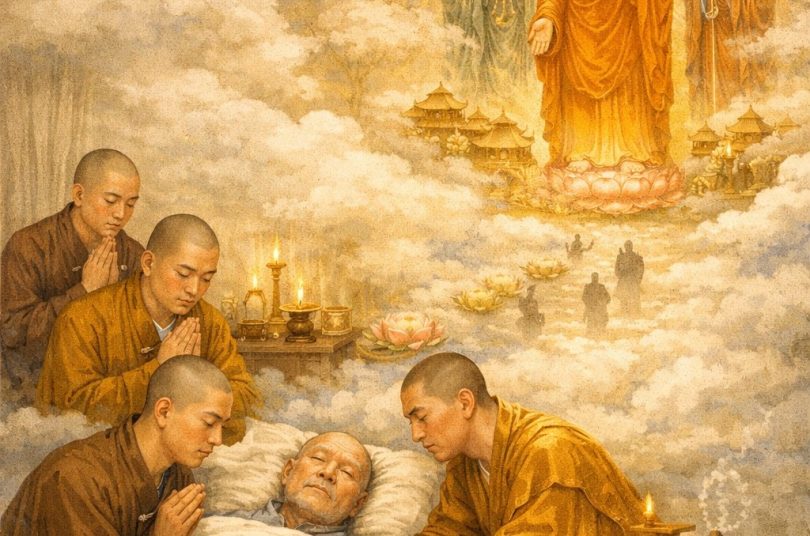
[525] 生死事大,人所不免,最后一着,念佛人应如何以同体之悲心,助临终人成就往生大事?
[525] [As] Birth [And] Death’s Matters Great, [Are] Those People Cannot Avoid, [For Their] Final One Move, How Should People Reciting [Āmítuó]fó[’s Name], With [The] Compassionate Mind Of [Having The] Same Body, Support People Approaching [Life’s] End [To] Accomplish Rebirth [In Pure Land’s] Great Matter?
◎ 世之最苦者莫过生死。生如活龟脱壳,死如螃蟹落汤,八苦交煎,痛不可言。愿诸照应病人者,细心谨慎,切莫与病人间谈杂话,令心散乱,亦勿悲哀喧哗。当劝病人放下身心,一心念佛,以求往生。
◎ [Summary (1]): Those [with] most suffering [in the] world [are with] none surpassing birth [and] death. [With] birth like [a] living turtle’s shell [being] removed, [and] death like [a] crab dropped [into] hot water, [with] eight sufferings together suffering, [the] pain [is] unspeakable. May all taking care [of] sick persons, [be] attentive, cautious [and] prudent. [There] must not [be] with sick persons, [in their] rooms discussing [with] miscellaneous words, [that] cause [their] minds [to be] scattered [and] confused. Also, [do] not [with] grief [create] clamour. [There] should [be] encouraging [of] sick persons [to] let go [of the] body [and] mind, [to] wholeheartedly recite [Āmítuó]fó[’s name (阿弥陀佛)], with seeking [of] rebirth [in his Pure Land].
◎ 古云:「我见他人死,我心热如火。不是热他人,看看轮到我。」因缘果报,感应无差。欲求自利,必先利他。
◎ [Summary (2)]: [The] ancients say, ‘I, [when] seeing other people die, my mind [becomes] hot like fire. Not hot [because of] other people, [but] seeing [that] pretty soon, [it will] become my turn.’ Causes, conditions [and] effects’ rewards [and retribution, are with] connections [and] responses without differences. Desiring [to] seek self-benefits, [there] must first [be] benefitting [of] others.
佛制亡僧焚化,原为令其离分段之假形,而证真常之法身也。故自佛立制以来,僧众奉为常规。
[The] Buddha’s regulation [of] deceased monastics [to be] cremated, [is] originally for enabling them [to] depart [from the] false forms of segmented [births and deaths (分段生死), to] then realise [the] true constant of [the] Dharma Body. Thus, since [the] Buddha established [the] regulation, [the] monastic assembly upholds [this] as [a] common practice.
奈法道陵夷,延久弊生,如今释子,率以焚化了事,不依制度。
It is a pity [that the] Dharma’s path [has] deteriorated, extending long [with] malpractices [that have] arisen. Nowadays, Śākyan children [i.e. the Buddha’s disciples], [are] hastily with cremation [to] complete [the] practice, not relying on [his] regulations.
每有以病者临脱气时,遽为穿衣搬动,及入龛一二日,即行焚化者,可谓大违佛制矣。
Very often, [there] are those with [the] sick, when approaching exhaustion [of their] breathing, hurriedly for [them] wearing [clean] clothes, moving, touching, and entering niches. [Within] one [to] two days, immediately doing cremation, [these] can [be] called [to be] great violations [of the] Buddha’s regulations.
佛说人有八识,即知识也。前五识,名眼耳鼻舌身,第六意识,第七末那,亦名传送识,第八阿赖耶,亦名含藏识。
[As the] Buddha said [that] humans have eight consciousnesses, then [to be] known [are these] consciousnesses. [The] first five consciousnesses, [are] named [as the] eye, ear, nose, tongue [and] body [consciousnesses. And there are the] sixth [mind] consciousness, [the] seventh Manas, [which is] also named [as the] Conveying Consciousness, [and the] eighth Ālaya, [which is] also named [as the] Containing Store[house] Consciousness.
夫人之生也,唯此第八识,其来最先,七六五识,次第后来。及其死也,亦此八识,其去最后,余识次第先去。
That [when] humans [are] born, [is] only this eighth consciousness. It comes first, [with the] seventh, sixth [and] fifth consciousnesseses, one after another later coming. And that [when] deceased, is also this eighth consciousness. It departs last, [with the] other consciousnesses one after another first departing.
盖第八识,即人之灵识,俗谓灵魂者是也。然此识既灵,故人初受母胎时,彼即先来,故儿在母胎中,即为活物。
Because [the] eighth consciousness, [is] then [the] spiritual consciousness of humans, [it is] that commonly called [the] ‘soul’. Thus, [with] this consciousness already spiritual, [when a] deceased person [is] first transferred within [the] mother’s womb, [s/he is] considered [to] be [a] living being.
至人死气断之后,彼不即去,必待至通身冷透,无一点暖气,彼识方去。
Until after [the] person dies, [with the] breathing stopped, that [person does] not immediately depart. [There] must [be] waiting until all [of the] body [is] cold throughout, without one bit [of] warmth, that [the] consciousness [has] then departed.
识去,则此身毫无知觉矣。若有一处稍暖,彼识尚未曾去。
[With the] consciousness departed, then [is] this body not in the least [with] knowing [and] feeling. If [there] is one place slightly warm, that consciousness [is] still not yet already departed.
动着触着,仍知痛苦,此时切忌穿衣盘腿搬动等事。
[With] moving [and] touching, still knowing pain [and] suffering, [at] this time, [it is] prohibited [to be with] wearing [of clean] clothes, crossing legs, moving, touching [and] other matters.
若稍触着,则其痛苦最为难忍,不过口不能言,身不能动而已。
If slightly touching, then [with] that pain [and] suffering [which] are most difficult [to] bear, only [with the] mouth not able [to] speak, [and the] body not able [to] move, that is all.
《考经》云:「寿暖识,三者常不相离。如人生有暖,则有识在,识在则寿尚未终。」
[The] Filiality Classic says, ‘[On] lifespan, warmth [and] consciousness, these three [are] constantly not apart [from] one another. Like people living having warmth, then having consciousness there, [and with] consciousness there, then [having] lifespan still yet [to] end.’
古来多有死去三五日而复生者,详载典章,历历可考。
Since ancient [times, there] are many [of] those [who have] died [for] three [to] five days, then resurrecting, [with these] detailedly recorded [in] decrees [and] regulations, [which] can [be] clearly understood [and] examined.
儒教亦有三日大殓之礼,缘眷属恩爱,尚望其万一复生耳。
[The] Confucian teachings also have three days’ rituals of encoffining, because [of] family members’ affection [and] love, still hoping [that] they [have] one [in] ten thousand [‘possibilities’ to] resurrect.
若我僧家,虽不望其复生,而亦不能不体其痛苦。
If [of] my monastic community, although not hoping they [will be] resurrected, [they are] then also not able [to] not experience that pain [and] suffering.
遽尔搬动,以及迁化,其慈悲之心安在哉?
[If] swiftly thus moving [and] touching, as well as changing [clothes], where is that heart [of] loving-kindness [and] compassion?
古云:「兔死狐悲,物伤其类。」物尚如此,而况同为人类,又况同为佛子者乎?
[The] ancients say, ‘[If the] rabbit dies, [the] fox grieves, animals grieve [for] their kind.’ Animals [are] still like this, then moreover those [the] same as humankind, also [the] same as [the] Buddha’s disciples?
且人情痛苦之极,嗔心易起。唯嗔心故,最易堕落。
Moreover, [with] those extreme human emotions [when having] pain [and] suffering, [the] angry mind easily arises. Only [with the] angry mind thus, [this is] most easy [to] fall.
如经云,阿耆达王,立佛塔寺,功德巍巍。临命终时,侍臣持扇,误堕王面,王痛起嗔,死堕蛇身。
Like [a] sūtra says, [as] King Ajita, established Buddhist pagodas [and] monasteries, [he had] meritorious virtues imposing. When approaching [life’s] end, [an] attending official holding [a] fan, accidentally [made it] fall [on the] King’s face, [with the] King painfully giving rise [to] anger, dying [and] falling [to be with a] snake’s body.
缘有功德,后遇沙门,为其说法。以闻法故,乃脱蛇身,而得生天。
[With his] condition [of] having meritorious virtues, [he] later met [a] Śramaṇa, for him speaking [the] Dharma. With hearing [of the] Dharma thus, [he] then escaped [from his] snake body, and attained birth [in a] heaven.
观此,可知亡者识未去时,即行穿衣搬动,及即焚化,使其因痛生嗔,更加堕落。
Looking at this, [it] can [be] known [that] when deceased persons’ consciousnesses [have] yet [to] depart, to immediately do wearing [of clean] clothes, moving [and] touching, and [to] immediately cremate, [these] enable them [to], because [of] pain, give rise [to] anger, [to be] even more [likely to] fall.
宁非忍心害理,故施惨毒?应思我与亡者何仇何恨,乃以好心而作恶缘?
How [is this] not having the heart [to] destroy [that] ethical, [to] purposely do [the] cruel? [There] should [be] contemplating, ‘I, with that deceased, [have] what hatred, [to] thus [have] good intentions yet create evil affinities?’
若云事属渺茫,无从稽考,则经典所载,岂可不信?
If speaking [of these] matters [as] belonging [to that] uncertain, with no way [to] investigate, then [with that the] sutras record, how can [they] not [be] believed?
迩来种种流弊,总因生者不怜死者之苦,只图迅速了事,故无暇细察冷暖,由是习以为常。
Recently, [there are] all kinds of malpractices, all because those living not sympathising [with the] suffering of those dying, only planning [to] quickly complete ‘practices’, thus not having time [to] observe warmth [and] coldness carefully. Due [to] this habit, with [it] as [the] usual.
纵有言及此者,反笑以为迂,致令亡者有苦难伸。
Even if [there] are those speaking, [when] reaching these [matters, they] instead laugh, with [this] as pedantic, causing those dying [to] have suffering [that is] difficult [to] redress.
呜呼,世之最苦者莫过生死。生如活龟脱壳,死如螃蟹落汤,八苦交煎,痛不可言。
Alas! Those [with] most suffering [in the] world [are with] none surpassing birth [and] death. [With] birth like [a] living turtle’s shell [being] removed, [and] death like [a] crab dropped [into] hot water, [with] eight sufferings together suffering, [the] pain [is] unspeakable.
愿诸照应病人者,细心谨慎,切莫与病人间谈杂话,令心散乱,亦勿悲哀喧哗。
May all taking care [of] sick persons, [be] attentive, cautious [and] prudent. [There] must not [be] with sick persons, [in their] rooms discussing [with] miscellaneous words, [that] cause [their] minds [to be] scattered [and] confused. Also, [do] not [with] grief [create] clamour.
当劝病人放下身心,一心念佛,以求往生。
[There] should [be] encouraging [of] sick persons [to] let go [of the] body [and] mind, [to] wholeheartedly recite [Āmítuó]fó[’s name (阿弥陀佛)], with seeking [of] rebirth [in his Pure Land].
又当助念,令病人随己念佛音声,心中系念。
Moreover, [there] should [be] support-chanting, [to] enable sick persons [to] follow one’s own reciting [of Āmítuó]fó[’s name’s] sound, within [the] mind [with] continual reciting.
若有钱财,当请众僧分班念佛,使佛声昼夜不断,令病人耳中常闻佛声,心中常念佛号,则决定可以仗佛慈力,往生西方。
If [there] is money [and] wealth, [there] should [be] inviting [of] many monastics [to] take shifts [to] recite [Āmítuó]fó[’s name, to] enable [the] Buddha’s sound, [in] day [and] night, [to] not [be] interrupted, [to] enable sick persons’ ears within, [to] constantly hear [the] Buddha’s sound, [with their] minds within constantly reciting [the] Buddha’s name, then definitely, can [there be] relying on [the] Buddha’s compassionate power, [to be] reborn [in his] Western [Pure Land Of Ultimate Bliss (极乐世界)].
即无钱财,亦宜大家发心助念,以结末后之缘。
Even if without money [and] wealth, [there] also should [be with] everyone giving rise [to the] Aspiration [to practise] support-chanting, with [this] forming that affinity [at the] end.
至于安置后事,切勿在病人前谈说。
As for arranging [of] funeral practices, [there] must not be, before sick persons, talking about [them].
只宜击引磬高声念佛,必使句句入病人耳,使彼心中常不离佛。
[It is] only suitable [to] strike [a] guiding bell, aloud reciting [Āmítuó]fó[’s name. There] must [be] enabling [of] line [after] line [to] enter sick persons’ ears, [to] enable their minds within [to] constantly not depart [from the] Buddha.
木鱼声浊,临终助念,断不宜用。
[As the] wooden fish’s sound [is] dull, [when] approaching [life’s] end [with] support-chanting, [it is] absolutely [not] suitable [to be] used.
任彼或坐或卧,切莫移动,大家专心念佛。
Allowing that [of] perhaps sitting or lying down, [there] must not [be] moving, [with] everyone focusing [their] minds [to] recite [Āmítuó]fó[’s name].
待至通身冷透,则神识已去,再迟二时,方可洗浴穿衣。
Waiting until all [of the] body [is] cold throughout, then [with the] consciousness already departed, again delaying [for] two hours, then can [there be sponge]-bathing [and] wearing [of clean] clothes.
如身冷转硬,应用热汤淋洗,将热布搭于臂肘膝弯,少刻即可回软,然后盘腿入龛。
If [the] body [when] cold [has] transformed [to be] stiff, [there] should [be] using [of] warm water [to] ‘soak’ [and] wipe, with [the] warm cloth attached to [the] arms’ elbows [and] knees’ bends, [which after] a short while, can then return [to be] soft. Afterwards, crossing [the] legs [to] enter [the] niche.
至诸事齐毕,尤须长为念佛。所有诵经拜忏,皆不如念佛之利益广大。
Until all practices [are] altogether complete, [there] must be especially long reciting [of Āmítuó]fó[’s name]. All those reciting [of] sūtras, [and] prostrating [with] repentance [prayers, are] all not as good as reciting [of Āmítuó]fó[’s name], that [is with] benefits vast [and] great.
凡一切出家在家各眷属,俱须依之而行,则存者亡者,悉得大益。
All [who have] left [the] house[hold life], householders [and] each family member, must together rely on this and practise. Then [will] those living [and] those deceased, all attain great benefits.
再者,我佛涅槃,原本右胁而卧,以故入棺荼毗。今人若随其自然,坐之者入龛,卧亡者入棺,尤为得当。
Furthermore, our Buddha’s [Pari]nirvāṇa, [was] originally [on his] right side then lying [down], therefore entering [a] coffin [for] cremation. If [for] people nowadays, following them naturally, [with] those sitting entering niches, [and] those lying [down] entering coffins, [this] is especially appropriate.
但今人沿习成风,恐不以此为然,亦唯听诸自便。
However, [as] people nowadays follow habits [that] become common practices, [I] fear [that they will] not regard this as right, [and] also only listen [to] many [others, as] personally pleased.
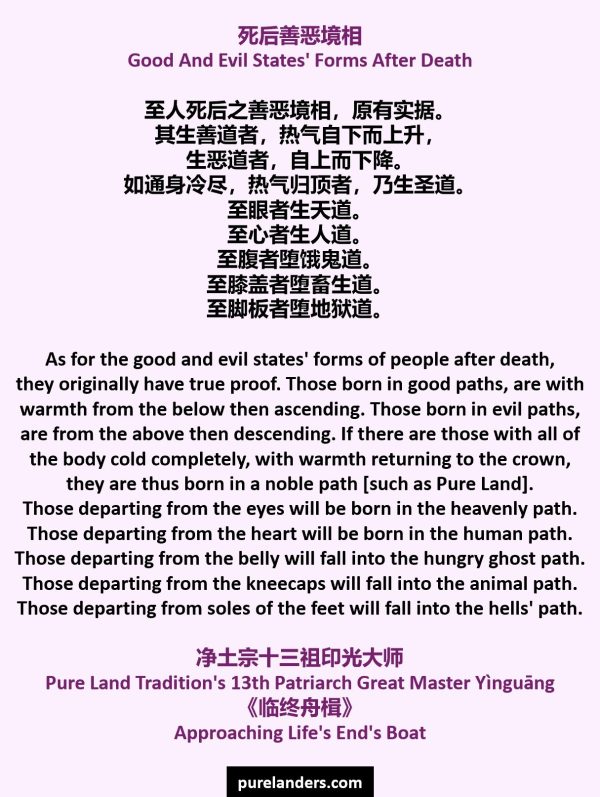
至人死后之善恶境相,原有实据。其生善道者,热气自下而上升,生恶道者,自上而下降。
As for [the] good [and] evil states’ forms of people after death, [they] originally have true proof. Those born [in] good paths, [are with] warmth from [the] below then ascending. Those born [in] evil paths, [are] from [the] above then descending.
如通身冷尽,热气归顶者,乃生圣道。
If [there are] those [with] all [of the] body cold completely, [with] warmth returning [to the] crown, [they are] thus born [in a] noble path [i.e. such as Pure Land].
至眼者生天道。至心者生人道。至腹者堕饿鬼道。至膝盖者堕畜生道。至脚板者堕地狱道。
Those departing [from the] eyes [will be] born [in the] heavenly path. Those departing [from the] heart [will be] born [in the] human path. Those departing [from the] belly [will] fall [into the] hungry ghost path. Those departing [from the] kneecaps [will] fall [into the] animal path. Those departing [from] soles [of the] feet [will] fall [into the] hells’ path.
故偈云:「顶圣眼天生,人心饿鬼腹,畜生膝盖离,地狱脚板出。」
Thus, [a] verse says, ‘[From the] crown [to be] sages [in Pure Land and from the] eyes [to be] heavenly [beings] born, [to be] humans [from the] heart [and] hungry ghosts [from the] belly, [to be] animals [from the] kneecaps [they] depart, [to be] hell-beings [from] soles [of the] feet [they] exit.’
夫生死事大,人所不免,最后一着,最宜慎重。
[As] these birth [and] death’s matters great, [are] those people cannot avoid, [for their] final one move, [there] should [be the] most caution.
其照应病人者,当以同体之悲心,助成往生之大事。
Those taking care [of] sick persons, should with [the] compassionate mind of [having the] same body, support [their] accomplishing of [the] great matter [of] rebirth [in Pure Land].
古云:「我见他人死,我心热如火。不是热他人,看看轮到我。」
[The] ancients say, ‘I, [when] seeing other people die, my mind [becomes] hot like fire. Not hot [because of] other people, [but] seeing [that] pretty soon, [it will] become my turn.’
因缘果报,感应无差。欲求自利,必先利他。述此遍告同胞,恳祈人各注意。
Causes, conditions [and] effects’ rewards [and retribution, are with] connections [and] responses without discrimination. Desiring [to] seek self-benefits, [there] must first [be] benefitting [of] others. Stating this everywhere [to] inform fellow countrymen, [I] sincerely request people [to] each pay attention [to this].
《临终舟楫》
Approaching [Life’s] End’s Boat
净土宗十三祖印光大师著
Written [By] Pure Land Tradition’s 13th Patriarch Great Master Yìnguāng
《印光法师答念佛600问》
Dharma Master Yìnguāng’s Answers [For] Mindfulness [Of] Buddha’s 600 Questions
卷十:净土法门与临终关怀
Scroll Ten: Pure Land Dharma Door And Care [When] Approaching [Life’s] End
传印法师鉴定
Evaluated [By] Dharma Master Chuányìn
上个问答
Previous Question And Answer:
断气后,最少应念几个小时的佛?
[524] After Stopping Of Breathing, What Should Be The Least Number Of Hours For Reciting Āmítuófó’s Name?
https://purelanders.com/2026/05/17/524-after-ending-of-breathing-what-should-be-the-least-number-of-hours-for-reciting-amituofos-name
全部问答
All Questions And Answers:
卷十:净土法门与临终关怀
Scroll Ten: Pure Land Dharma Door And Care When Approaching Life’s End
https://purelanders.com/2026/06/12/pure-land-dharma-door-and-care-when-approaching-lifes-end
Námó Āmítuófó : Translation and notes by Shen Shi’an
相关教理
Related Teachings:
《临终三大要》: 原文·白话·详解
The Three Great Essentials When Approaching Life’s End: Original, Simplified And Explanatory Text
https://purelanders.com/now

死亡前后与丧礼中后的诵念
Chanting When Dying, After Death, During & After Wakes
https://purelanders.com/wake