Question: In the Amitabha Sutra, the Buddha addresses his teachings to Good Men and Good Women (善男子, 善女人; Kulaputra and Kuladuhitri) Who are they? [See (Part 1) and (Part 2) for Chinese-English Sutra]
Answer: Generally, men and women who have faith in the Buddha, who learn the Dharma, who also do good are called so. The Kulaputra Sutra (善男子经) from the Samyukta Agamas (杂阿含经) says this:
谓杀生者,乃至邪见者,是名不善男子。
云何善男子?
谓不杀生,乃至正见,是名善男子。Those who kill, even up to having wrong views, are called Not-Good Men.
Who is a good man?
Those who do not kill, even up to having right views, are called Good Men.
Expanded, this means those who engage in the Ten Unwholesome Deeds of…
- killing
- stealing
- sexual misconduct
- divisive speech
- harsh speech
- false speech
- idle speech
- greed
- anger
- wrong views …
are Not-Good Men. Conversely, this means those who abstain from the above, who thus practise the Ten Wholesome Deeds (不杀生、不偷盗、不邪淫、不妄语、不两舌、不恶口、不绮语、不贪欲、不嗔恚、不邪见) are called Good Men. (This of course applies for women too.)
Q: Does this mean that the Amitabha Sutra’s teachings are only for Good Men and Good Women as defined?
A: The teachings are for everyone. In fact, they are all the more precious for those who are not yet very Good Men or Good Women, as they remind them to be better people. In the context of the Amitabha Sutra, when we hear or read of the Buddha addressing the audience as Good Men and Good Women, and if we heed the given advice, without engaging in any of the Ten Unwholesome Deeds in that moment, we are also Good Men and Good Women then.
To be able to truly hear and heed the teachings in the Amitabha Sutra requires some Good Roots (善根) too. We are truly Good Men and Good Women when we are able to deepen these Good Roots, to perpetuate the Ten Wholesome Deeds. When one really heeds the advice, one should also do one’s best to be a better Good Man or Good Woman thereafter. If not, it would be insincere; not really heeding the advice in the first place, which makes one not a true Good Man or Good Women earlier. On a related note, here is what Venerable Master Ou Yi (the Ninth Patriarch of Chinese Pure Land Buddhism) taught:
‘When the sutra speaks of “Good Men and Good Women”, it does not matter whether they are monks and nuns or householders, or whether they are high-ranking or low-ranking or old or young. No matter what your station in life, all you have to do is *hear* the Buddha-name, and the Good Roots you have accumulated over many eons immediately ripen, and all forms of evil and perversity are transformed into virtues.’ (Mind-Seal of the Buddha)
It can be interpreted that to *hear* (as above) is to be truly mindful of Amitabha Buddha’s name with deep faith. When we are mindful of Buddha in the moment, it is impossible to engage in any of the Ten Unwholesome Deeds at the same time – as we can only have one thought in each moment, and that mindfulness of Buddha is mindfulness of purity. Further practice of mindfulness of Buddha further reduces the tendencies of doing the Ten Unwholesome Deeds.
Q: Are all Good Men and Good Women supposed to have no sexual desire (淫欲)?
A: ‘No sexual misconduct’ (不邪淫), as listed in the Ten Wholesome Deeds, is different from ‘no sexual activities’ (不淫). The latter is a rule for monastics, who are supposed to be fully committed to eradicating lust. For them, any form of sexual activity would be sexual misconduct, while for laypersons, sex that abides by the lay precepts is allowable. (A way to lessen or curb lust is to more diligently practise mindfulness of Buddha. As above, when one is properly mindful of Buddha in the moment, defilements, including lust, cannot arise in the same moment.)
However, under ‘no greed’ (不贪欲), as listed in the Ten Wholesome Deeds, the definition disallows greed or desire in the strictest sense, including sexual desire. If you think of carefully, if one fully abides by all the ten conditions which constitute perfect Good Men and Good Women, it would equate to becoming Buddhas – since ‘no greed, no anger, no wrong views’ (不贪欲、不嗔恚、不邪见), as listed means no attachment, aversion and delusion (Three Poisons) at all!
However, the Buddha was, obviously, in the Amitabha Sutra, not addressing Buddhas, but non-Buddhas, who would include us, when we learn about this sutra. The full standards of being Good Men and Good Women should thus be worked towards, while not thinking we have to be perfect Good Men and Good Women in order to practise mindfulness of Buddha. If we are perfect already, there would be no need to practise! An encouraging note by Master Ou Yi says:
‘With his great vows, Amitabha creates the causal basis for sentient beings to multiply their Good Roots, and with his great deeds he creates the conditions for sentient beings to increase their merits [store of goodness].’ (Mind-Seal of the Buddhas)
As such, we need to remember that it is exactly because we are not perfect Good Men and Good Women, that we aspire to be reborn in Pure Land – to train to become perfect. Every time the Buddha calls out to Good Men and Good Women, he is reminding us to be diligent in becoming better men and women! The better we are in conduct, the easier it would be for us to be reborn in Pure Land, as being good helps to fulfill the Three Acts of Merit too, which facilitate birth in Pure Land.
Question: Can you give more assurance as to how I can become a Good Man or Good Woman?
Answer: Let us take a look at the lowest grade of birth in Pure Land, as stated in the Contemplation Sutra:
The Buddha said to Ananda and Vaidehi, ‘Those who attain birth on the lowest level of the lowest grade are the sentient beings who commit such evils as the five gravest offenses, the ten evil acts and all kinds of immorality. Owing to such evil karma, the fool like this will fall into evil realms and suffer endless agony for many kelps.
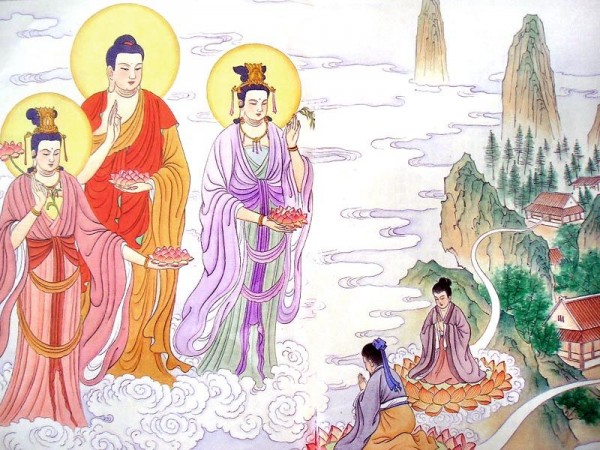
When he is about to die, he may meet a good teacher, who consoles him in various ways, teaching him the wonderful Dharma and urging him to be mindful of the Buddha; but he is too tormented by pain to do so. The good teacher then advises him, ‘If you cannot concentrate on the Buddha, then you should say instead, Homage to Amitayus Buddha.’ In this way, he sincerely and continuously says ‘Homage to Amita Buddha’ [Na-mo-A-mi-tuo-fo] ten times. Because he calls the Buddha’s Name, with each repetition, the evil karma which he has committed during eighty kotis of kalpas of Samsara is extinguished. When he comes to die, he sees before him a golden lotus-flower like the disk of the sun, and in an instant he is born within a lotus-bud in the Land of Utmost Bliss.
Though the first bolded part clearly describes one who is the direct opposite of a Good Man or Good Woman, the second bolded part however explains that if he or she is able to repent and practise in time and accordingly with faith and aspiration, he or she can still be born in Pure Land. This is an extreme example of how one can still become a Good Man or Good Woman in the very last minute, even if one was very evil before.
Not that we should emulate the case above (for we might not be able to repent and practise in time), but we should have some confidence from this, that if we do not engage in such great evils, while we are diligently increasing our Three Provisions of faith, aspiration and practice, our affinities for being born in Pure Land will be even much greater.
Incidentally, Buddha mindfulness is the only Dharma practice that can help avert an otherwise ‘destined’ rebirth in the lower realms (the worst being the hells) due to great evils done. This is possible by utilising the Buddha’s compassionate sharing of his merits with anyone who is adequately mindful of him. His boundless merits are always much more than all of the negative karma created by an individual, which makes it capable of depowering the latter to a great extent. It should be noted that, generally, the greater evil one has done, the more difficult it will be to repent in time, before rebirth. As such, we should always avoid doing evil and do as much good as we can instead, thus being Good Men and Good Women. Many little evils can amass to be great negative karma, which leads to great regret that disturbs peace of mind, thus jeopardising proper practice of Buddha mindfulness while alive and on the deathbed.