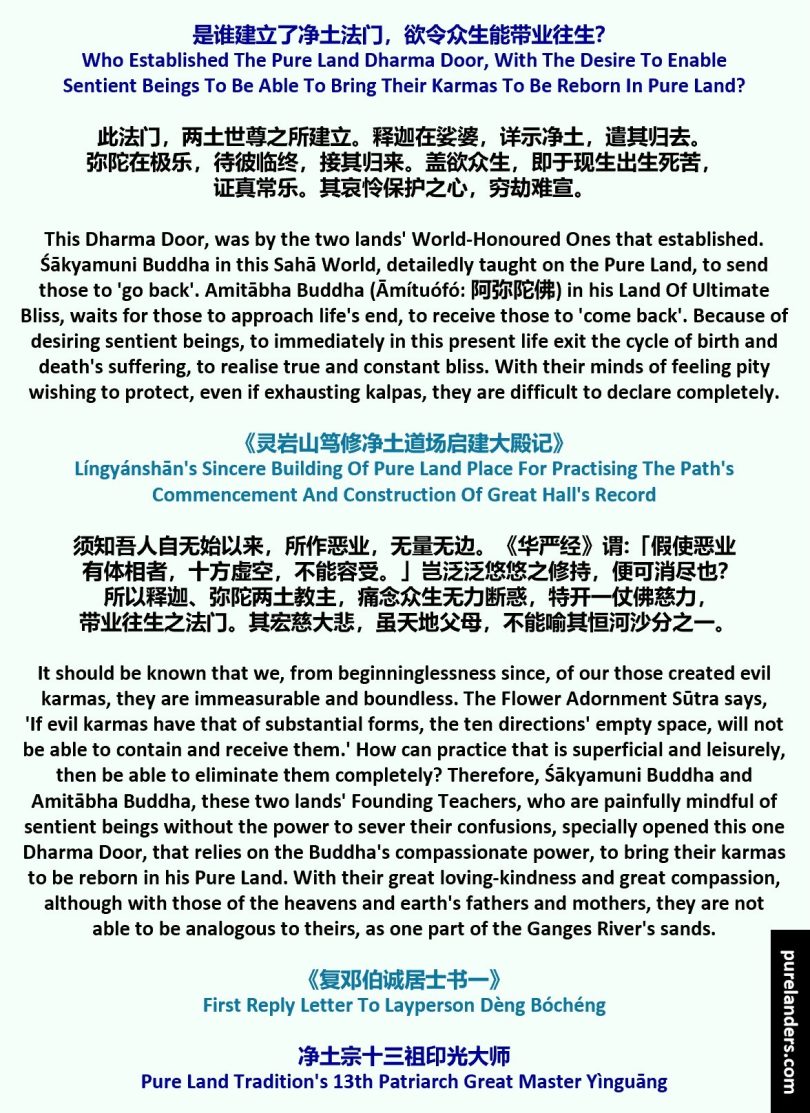
[19] 是谁建立了净土法门,欲令众生能带业往生?
[19] Who Established [The] Pure Land Dharma Door, [With The] Desire [To] Enable Sentient Beings [To Be] Able [To] Bring [Their] Karmas [To Be] Reborn [In Pure Land]?
◎ 两土世尊之所建立。盖欲众生,即于现生出生死苦,证真常乐。
◎ [Summary]: [By the] two lands’ World-Honoured [Ones] that established. Because [of] desiring sentient beings, [to] immediately in [this] present life exit [the cycle of] birth [and] death’s suffering, [to] realise true [and] constant bliss.
然此法门,两土世尊之所建立。释迦在娑婆,详示净土,遣其归去。弥陀在极乐,待彼临终,接其归来。
However, this Dharma Door, [was by the] two lands’ World-Honoured [Ones] that established. Śākya[muni Buddha] in [this] Sahā [World], detailedly taught [on the] Pure Land, [to] send those [to] ‘go back’. [A]mitā[bha Buddha] [i.e. Āmítuófó: 阿弥陀佛] in [his Land Of] Ultimate Bliss, waits [for] those [to] approach [life’s] end, [to] receive those [to] ‘come back’.
盖欲众生,即于现生出生死苦,证真常乐。
Because [of] desiring sentient beings, [to] immediately in [this] present life exit [the cycle of] birth [and] death’s suffering, [to] realise true [and] constant bliss.
其哀怜保护之心,穷劫难宣。
[With] their minds of feeling pity [wishing to] protect, [even if] exhausting kalpas, [they are] difficult [to] declare [completely].
《灵岩山笃修净土道场启建大殿记》
Língyánshān’s Sincere Building [Of] Pure Land Place [For Practising The] Path’s Commencement [And] Construction [Of] Great Hall’s Record
须知吾人自无始以来,所作恶业,无量无边。
[It] should [be] known [that] we, from beginninglessness since, [of our] those created evil karmas, [they are] immeasurable [and] boundless.
《华严经》谓:「假使恶业有体相者,十方虚空,不能容受。」岂泛泛悠悠之修持,便可消尽也?
[The] Flower Adornment Sūtra says, ‘If evil karmas have that [of] substantial forms, [the] ten directions’ empty space, [will] not [be] able [to] contain [and] receive [them].’ How can practice that [is] superficial [and] leisurely, then [be] able [to] eliminate [them] completely?
所以释迦、弥陀两土教主,痛念众生无力断惑,特开一仗佛慈力,带业往生之法门。
Therefore, Śākya[muni Buddha and [A]mitā[bha Buddha] [i.e. Āmítuófó: 阿弥陀佛], [these] two lands’ Founding Teachers, [who are] painfully mindful [of] sentient beings without [the] power [to] sever [their] confusions, specially opened [this] one Dharma Door, that relies on [the] Buddha’s compassionate power, [to] bring [their] karmas [to be] reborn [in his Pure Land].
其宏慈大悲,虽天地父母,不能喻其恒河沙分之一。
[With] their great loving-kindness [and] great compassion, although [with those of the] heavens [and] earth’s fathers [and] mothers, [they are] not able [to be] analogous [to] theirs, [as] one part of [the] Ganges River’s sands.
《复邓伯诚居士书一》
First Reply Letter [To] Layperson Dèng Bóchéng
净土宗十三祖印光大师著
Written [By] Pure Land Tradition’s 13th Patriarch Great Master Yìnguāng
《印光法师答念佛600问》
Dharma Master Yìnguāng’s Answers [For] Mindfulness [Of] Buddha’s 600 Questions
传印法师鉴定
Evaluated [By] Dharma Master Chuányìn
Námó Āmítuófó : Translation by Shen Shi’an