《要解》开序文
[1] The Essential Explanation’s Opening Preface Text
前言
Foreword
一、两种题目
One: Two Kinds [Of] Titles
分二:初、经题,二、疏题。
Divided [In] Two [Parts]: First, Sūtra’s Title, Second, Commentary’s Title.
甲初、经题
A1: Sūtra’s Title
《佛说阿弥陀经》
Sūtra [In Which The] Buddha Speaks [Of] Amitā[bha Buddha]
甲二、疏题
A2: Commentary’s Title
《要解》
Essential Explanation
二、译经法师
Two: Dharma Master [Who] Translated Sūtra
姚秦三藏法师鸠摩罗什译
[By] Yáo Qín [Dynasty’s] Tripiṭaka Dharma Master Kumārajīva translated
三、解经大师
Three: Great Master [Who] Explained Sūtra
清西有沙门蕅益智旭解
[By] Qīng [Dynasty’s] West Is Śramaṇa Ǒuyì Zhìxù explained
[Note 1: ‘West Is‘ (西有) is the Master’s self-given name, that reminds us of the two ‘is‘ (二有) in the opening of the sūtra’s Preface Section (序分) — ‘From here, in the western direction, passing a hundred thousand koṭis of Buddha lands, is a world named “Ultimate Bliss”. In that land, is a Buddha named “Amitā(bha)”, now presently speaking the Dharma.’ (从是西方,过十万亿佛土,有世界名曰极乐。其土有佛,号阿弥陀,今现在说法。)]
四、著解序文
Four: Written Explanation’s Preface Text
文分二:初、序法门,二、序注疏。
Text Divided [In] Two [Parts]: First, Preface [On] Dharma Door, Second, Preface [On] Commentaries [And] Sub-commentaries.
甲初、序法门
A1: Preface [On] Dharma Door
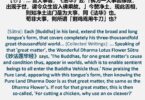
【解】: 原夫诸佛悯念群迷,随机施化,虽归元无二,而方便多门。
[Explanation]: Originally, those all Buddhas, [with] sympathetic mindfulness [of the] multitudes confused, according [to their] capacities gave [teachings to] transform [them]. Although return [to that] original [is] not two, yet skilful [means have] many doors.
然于一切方便之中,求其至直捷、 至圆顿者,则莫若念佛求生净土。
However, of all within those skilful [means], seeking that utmost straightforward, utmost perfect [and] sudden, then [is] nothing better than [to be] mindful [of] Buddha [to] seek birth [in his] Pure Land.
又于一切念佛法门之中,求其至简易、至稳当者,则莫若信愿专持名号。
Also, of all within that Mindfulness [Of] Buddha’s Dharma Door, seeking that utmost easy, [and] utmost reliable, then [is] nothing better than [to be with] Faith [and] Aspiration focused [on] upholding [Āmítuófó’s] name.
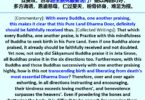
是故《净土三经》并行于世,而古人独以《阿弥陀经》列为日课,
Therefore, [with the] Pure Land [Tradition’s] Three Sūtras together practised in [this] world, yet ancient persons [are] only with [the] Amitā[bha] Sūtra, classified as [part of] daily [chanting] practice.
[Note 2: Together with the Immeasurable Life Sūtra《无量寿经》and the Contemplation Sūtra《观经》, these are the Pure Land Tradition’s Three Sūtras《净土三经》.]
岂非有见于持名一法,普被三根,摄事理以无遗,统宗教而无外,尤为不可思议也哉!
How can it not [be due to] having seen, [that] upholding [the] name, [this] one Dharma [Door], universally covers [the] Three Roots, gathers practices [and] principles without omission, unifies [the] essential [and] teachings, yet without exclusion, [is that] especially inconceivable?
[Note 3:
Three Roots (三根):
(1) High(er) Roots (上根)
(2) Medium / Average Roots (中根)
(3) Low(er) Roots (下根)]
[Note 4: ‘宗教’ means ‘essential and teachings’, with ‘宗’ (essential) short for ‘宗门’ (Essential Door), referring to 禅宗, the ‘Chán Tradition’, and ‘教’ (teachings) short for ‘教下’ (Teachings Below), referring to all scripturally-based traditions, such as the Tiāntái Tradition (天台宗), Consciousness-Only Tradition (唯识宗), Flower Adornment Tradition (华严宗) and others.]
甲二、序注疏
A2: Preface [On] Commentaries [And] Sub-commentaries
古来注疏,代不乏人,世远就湮,所存无几。
Since ancient times, [of] people [who wrote] commentaries [and] sub-commentaries, [over the] ages, there is no lack of [them, but by] generations separated then obscured, [those] that remain [are] very few.
云栖和尚著为《疏钞》,广大精微。
[By the] Most Venerable Yúnqī written as [the] Sub-Commentary’s Collected Writings, [it is] vast [and] great, refined [and] subtle.
[Note 5: Sub-Commentary’s Collected Writings《疏钞》is short for the Amitābha Sūtra’s Sub-Commentary’s Collected Writings《阿弥陀经疏钞》by Míng Dynasty’s Pure Land Tradition’s 8th Patriarch (净土宗八祖) Great Master Liánchí (莲池大师).]
幽溪师伯述 《圆中钞》,高深洪博。
[By my] Teacher’s [Dharma] Brother Master Yōuxī elaborated, [the] Perfect Middle’s Collected Writings, [it is] lofty [and] profound, great [and] extensive.
[Note 6: Perfect Middle’s Collected Writings《圆中钞》is short for the Amitābha Sūtra’s Brief Explanation On The Perfect Middle Path’s Collected Writings《阿弥陀经略解圆中钞》by Míng Dynasty’s (明代) Tiāntái Tradition’s Great Master Chuándēng (传灯大师).]
盖如日月中天,有目皆睹。
Covering [all with light] like [the] sun [and the] moon [in the] middle [of the] sky, [those who] have eyes all [can] see [them].
特以文富义繁,边涯莫测,或致初机浅识,信愿难阶。
Especially with text abundant [and] meanings complex, [with] boundaries [that] cannot [be] measured, perhaps leading [to] beginners [with] shallow knowledge, [to be with] Faith [and] Aspiration difficult [to] arise.
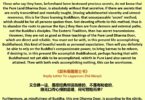
故复弗揣庸愚,再述《要解》。
Therefore again, not considering [my] mediocrity [and] ignorance, [am] again elaborating [with this] Essential Explanation.
不敢与二翁竞异,亦不必与二翁强同。
Not daring [to be] with [these] two elders contending [to have] different [explanations], also not needing [to be] with [these] two elders forcibly [having the] same.
譬如侧看成峰,横看成岭,纵皆不尽庐山真境,要不失为各各亲见庐山而已。
For example, like [with] sideways seeing becoming peaks, [and with] horizontally seeing becoming ridges, even if all [do] not completely [see] Mount Lú’s true realm, [this] essentially can still be considered to be [that] respectively [and] personally seen [of] Mount Lú, that is all.
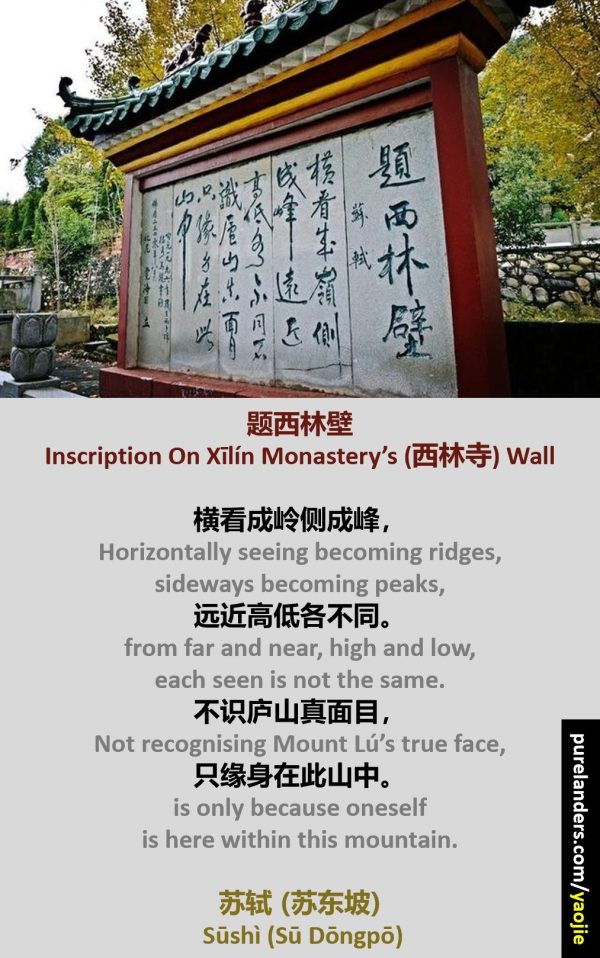
[Note 7: This analogy was derived from the poem titled Inscription On Xīlín Monastery’s (西林寺) Wall《题西林壁》by Sū Shì (苏轼) or Sū Dōngpō (苏东坡), who happened to be the spiritually backslided Wǔzǔshān Monastery’s (五祖山寺) Chán Master Shījiè (师戒禅师) reborn, as he did not practise to reach Pure Land.
横看成岭侧成峰,
远近高低各不同。
不识庐山真面目,
只缘身在此山中。
Horizontally seeing becoming ridges, sideways becoming peaks,
(from) far (and) near, high (and) low, each (seen is) not (the) same.
Not recognising Mount Lú’s true face,
(is) only because (one)self is here within this mountain.
With our great ignorance, while we might only see incomplete facets of the profound Pure Land teachings now, it is with the reaching of Pure Land, with completion of Dharma learning and practice there, that they can be known and seen completely, when Buddhahood is attained.]
[Note 8: The Pure Land Tradition’s First Patriarch Great Master Huìyuǎn’s (净土宗初祖慧远大师) senior Dharma Brother (师兄) Huìyǒng (慧永法师) was already the Abbot (方丈) of Xīlín (Western Forest) Monastery (西林寺), which was established in 377 C.E., when the Great Master arrived at Mount Lú (庐山), with his brother Dharma Master Huìchí (慧持法师) staying there to practise the Pure Land teachings later.
As Xīlín Monastery was small, Dharma Master Huìyǒng requested Jiāngzhōu’s Regional Inspector Huányī (江州刺史桓伊) to build Dōnglín (Eastern Forest) Monastery (东林寺), which was established in 384 C.E., for the Great Master, which became the founding patriarchal monastery (祖庭) of the Pure Land Tradition (净土宗), with the two monasteries within a short walking distance from each other.]
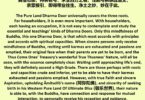
– 净土宗九祖蕅益大师
《佛说阿弥陀经要解》
– Pure Land Tradition’s 9th Patriarch Great Master Ǒuyì
(Essential Explanation [Of The] Sūtra [In Which The] Buddha Speaks [Of] Amitā[bha] Buddha)
Namo Amituofo : Translation and notes by Shen Shi’an
相关教理
Related Teachings:
下文: 释《阿弥陀经》名
Next Section: Explanation Of Amitābha Sūtra’s Name
第一重玄义
The First Layer Of Profound Meaning
https://purelanders.com/2019/10/11/explanation-of-amitabha-sutras-name-the-first-layer-of-profound-meaning
《佛说阿弥陀经要解》全英译
Complete English Translation Of The Essential Explanation Of The Sūtra In Which The Buddha Speaks Of Amitābha Buddha
https://purelanders.com/yaojie