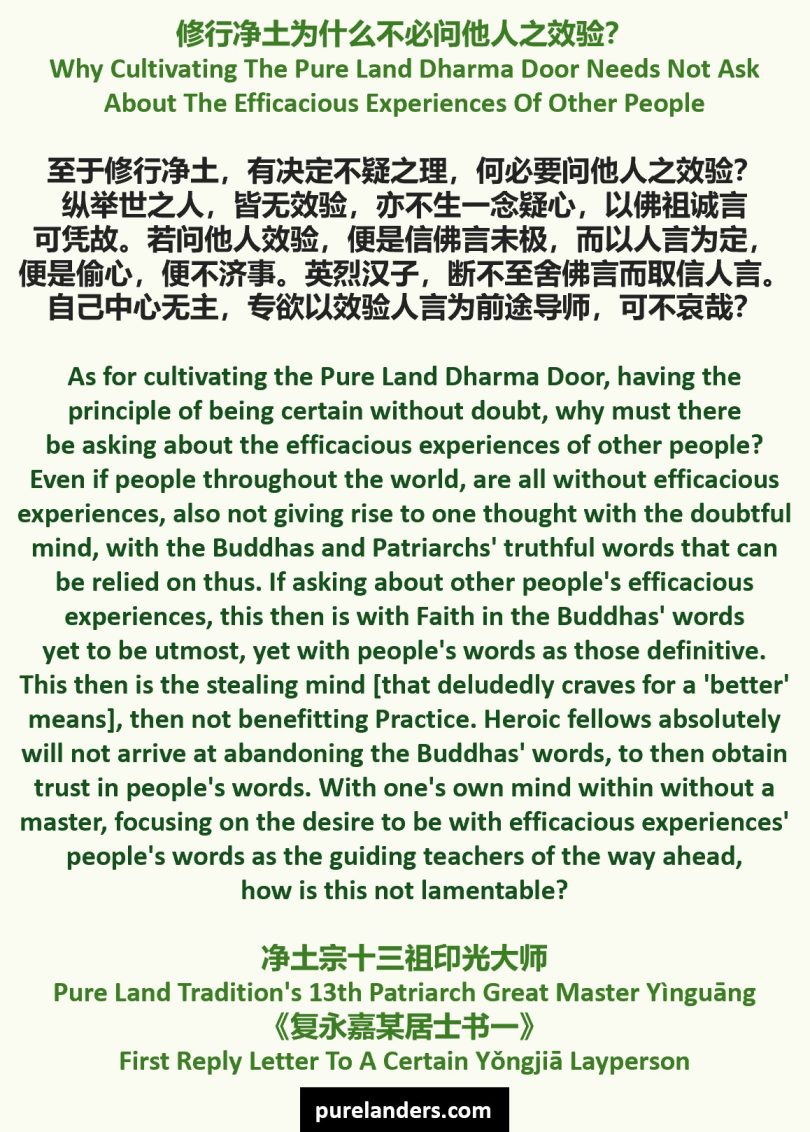
[261] 修行净土为什么不必问他人之效验?
[261] Why Cultivating [The] Pure Land [Dharma Door] Needs Not Ask [About The] Efficacious Experiences Of Other People
◎ 以佛祖诚言可凭故。若问他人效验,便是信佛言未极,而以人言为定,便是偷心,便不济事。
◎ [Summary]: With [the] Buddhas [and] Patriarchs’ truthful words [that] can [be] relied on thus. If asking [about] other people’s efficacious experiences, [this] then is [with] Faith [in the] Buddhas’ words yet [to be] utmost, yet with people’s words as [those] definitive. [This] then is [the] stealing mind [i.e. that deludedly craves for a ‘better’ means], then not benefitting Practice.
至于修行净土,有决定不疑之理,何必要问他人之效验?
As for cultivating [the] Pure Land [Dharma Door], having [the] principle of [being] certain without doubt, why must [there be] asking [about the] efficacious experiences of other people?
[Note 1: This is very important as to have definite Faith is to adequately accumulate the very first of the Three Provisions (三资粮), of Faith (信), Aspiration (愿) and Practice (行) for reaching Pure Land. When there are doubts, there should be more sincere learning and practice, with swift clarification through the Buddhas words and the Patriarchs’ further explanations. When teachers’ advice is sought, only that with proper references to the Buddhas and Patriarchs should be heeded.]
[Note 2: Testimonies of good and successful practice are only valid if they are aligned with the principles taught by the Buddhas and Patriarchs. In this sense, they are secondary to the principles; never preceding them in trustworthiness. Only testimonies referred to in this way can be inspiring examples for increasing our Faith.]
纵举世之人,皆无效验,亦不生一念疑心,以佛祖诚言可凭故。
Even if people throughout [the] world, [are] all without efficacious experiences, also not giving rise [to] one thought [with the] doubtful mind, with [the] Buddhas [and] Patriarchs’ truthful words [that] can [be] relied on thus.
[Note 3: Even if there are no contemporary people with efficacious experiences, there are ancient ones. Even if there are no ancient ones, the Buddha’s explanations and assurances in the sūtras should suffice for inspiring our Faith. Of course, there are already countless ancient and contemporary people with efficacious experiences.]
[Note 4: If there is uncertainty about the meaning of Patriarchs’ words as understood, they should be checked with the Buddhas’ words as the primary source of reference.]
若问他人效验,便是信佛言未极,而以人言为定,便是偷心,便不济事。
If asking [about] other people’s efficacious experiences, [this] then is [with] Faith [in the] Buddhas’ words yet [to be] utmost, yet with people’s words as [those] definitive. [This] then is [the] stealing mind [i.e. that deludedly craves for a ‘better’ means], then not benefitting Practice.
[Note 5: This is to be inverted, as there should be accumulating of Faith in the Buddha’s words to the utmost first, before checking if others’ words are aligned to them. If there is listening to many of others’ words without paying attention to the Buddha’s words first, there might be confusion to no end, while always missing the truth.]
[Note 6: This is to, with confusion and greed, look for what does not exist, a better and/or easier method beyond what the Buddhas have taught. This is not only not helpful, but also harmful as the right priority and focus will be lost.]
英烈汉子,断不至舍佛言而取信人言。
Heroic fellows absolutely [will] not arrive [at] abandoning [the] Buddhas’ words, [to] then obtain trust [in] people’s words.
[Note 7: As true disciples of the Buddha, we should have unshakeable Faith in the Buddhas’ truthful words, instead of the words of unenlightened and possibly confused ordinary beings.]
自己中心无主,专欲以效验人言为前途导师,可不哀哉?
[With one’s] own mind within without [a] master, focusing [on the] desire [to be] with efficacious experiences’ people’s words as [the] guiding teachers [of the] way ahead, how [is this] not lamentable?
[Note 8: We should have Śākyamuni Buddha (释迦牟尼佛) as our fundamental teacher (本师) in mind, who also taught us about what other Buddhas (i.e. including Āmítuófó [阿弥陀佛]) taught. Being able to do so is already fortunate enough. What more, there are the 13 Pure Land Patriarchs’ further explanatory teachings for support. All these are already adequate.]
《复永嘉某居士书一》
First Reply Letter [To A] Certain Yǒngjiā Layperson
净土宗十三祖印光大师
Pure Land Tradition’s 13th Patriarch Great Master Yìnguāng
《印光法师答念佛600问》
Dharma Master Yìnguāng’s Answers [For] Mindfulness [Of] Buddha’s 600 Questions
释宗柱法师审阅
[By] Dharma Master Shì Zōngzhù Reviewed
Namo Amituofo : Translation and notes by Shen Shi’an