一位学生如何点化找替身之鬼的故事
The Story Of How A Student ‘Enlightened’ A Ghost Seeking A Substitute
From ‘Continuation Of What The Master Does Not Speak’ 《续子不语》 , which is a collection of more than 200 strange events by the Qīng Dynasty scholar Yuán Méi (袁枚), circa 1788, is this fascinating account titled ‘Breaking Ghosts’ “Rule”‘ 《打破鬼例》, with additional explanatory notes.
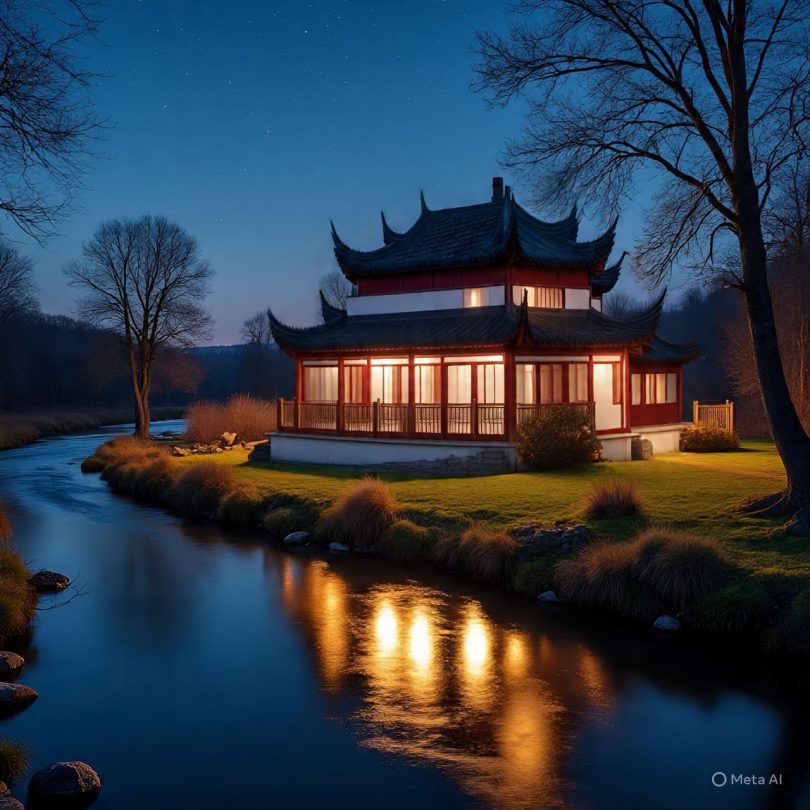
Student Lǐ was in the night studying, in his home near a river, next to it, when he heard a ghost say, ‘Tomorrow, a certain person will be coming to cross the river. This person will be my substitute.’ (李生夜读,家临水次,闻鬼语:「明日某来渡水,此我替身也。」)
[Note 1: This ghost, who was most likely drowned, was probably talking to another ghost about his plan to drown the person, with this overheard. There are some ghosts who deludedly assume that they should kill someone, (or urge someone to kill themselves), so that they themselves can move on, to be reborn or be ‘liberated’ from their suffering. They thus try to ‘catch a replacement’ (抓交替), to become a ‘scapegoat ghost after dying on their behalf’ (替死鬼).
Obviously, this does not make sense karmically, as to cause killing (or commit murder) creates worse evil karmas, only leading to worse rebirths. However, as long as there are those who believe this, they might die to become such ghosts, who cause others to become similar ghosts, if the latter also have similar beliefs.]
Arriving at the next day, there really was a person, who came to cross the river. As Lǐ forcibly prevented it, this person did not cross and left. (至次日,果有人来渡。李力阻之,其人不渡而去。) At night, the ghost came and blamed him, saying, ‘What matter do you have with me, to then cause me to not obtain my substitute?’ (夜,鬼来责之曰:「与汝何事,而使我不得替身?」)
[Note 2: Ironically, a similar question could be asked by the person, if he did die due to the ghost’s sabotage, ‘What matter do you have with me, to then cause me to be your substitute?’ There might then be a vicious cycle of grudge-bearing indignation, inflicted upon one another, and even the next stranger who passes by.]
Lǐ asked, ‘Why must your rebirth have a substitute?’ (李问:「汝等轮回,必须替身何也?」) The ghost said, ‘As the netherworld’s (i.e. underworld; hell) usual custom is like this, I also do not know that place it started from. This is also like that human world’s filling of a government granary, and maintaining of an office, which must be with waiting for vacancies, those leaving, (before refilling and replacing them). I think these are with the same one principle.’ (鬼曰:「阴司向例如此,我亦不知其所自始,犹之人间补廪[lǐn]补官必待缺出,想是一理。」)
[Note 3: (i) There was misunderstanding that all humans will (first) go to the hells for ‘judgement’ after death. This is so only for those who have done great enough evils to fall into the hells, and those whose karmas are too mixed and ambiguous (at first), while most are reborn in their relevant realms directly, even if not immediately. (ii) There was admitting of ignorance about origin of the toxic misconception, of needing substitute ghosts before having rebirths. (iii) There was then giving of two seemingly reasonable but delusional analogies to rationalise the misconception.]
Lǐ knew this and said, ‘You have mistaken! A government granary has grain, and an office has wages. As all are the country’s money and grain, they must not be in vain wasted. Thus having fixed limits, they must not be not thus. If humans’ births between the heavens and the earth, are with the Yīn and the Yáng (i.e. complementing factors) incited and agitated (i.e. interacting), they naturally cease and naturally arise, “with that personally eaten according to one’s efforts”. (李晓之曰:「汝误矣!廪有粮,官有俸,皆国家钱粮,不可虚靡,故有额限,不得不然。) How can creation (创造) and evolution (演化) (i.e. nature) have time (and efforts) to manage these unrelated accounts?’ (若人生天地间,阴阳鼓荡,自灭自生,自食其力,造化那有工夫管此闲帐耶?」)
[Note 4: As rebirths (轮回) can occur automatically at any time, for an immeasurable number of beings, and for an immeasurable number of times, due to the natural law of karma (业), once causes (因) and conditions (缘) bear effects (果), there need not be waiting for another to replace one’s position in life or death.
Although there are ghosts and gods (鬼神) keeping tabs of human rights and wrongs done and undone, even these are expressions of karma at work, while they are not necessarily the ones rewarding and punishing those kept tabs of, which are also expressions of karma. The law of karma itself already keeps tabs on everyone, and affects all accordingly.]
[Note 5: The fact that a human was killed due to a ghost seeking a substitute is still karmic in nature, in this sense with the ghost negatively karmically related to the human, although such killing was not needed for the ghost to be reborn, thus with it morally wrong.]
The ghost said, ‘I heard that the Wheel-Turning King truly manages these accounts.’ (鬼曰:「闻转轮王实管此帐。」) Lǐ said, ‘You can immediately with my these words, go to ask the Wheel-Turning King. If the King assumes it is essential to have a substitute, you can immediately come to pull me down (to the river) to become your substitute. With this, then can I see the Wheel-Turning King. I will to his face scold him.’ (李曰:「汝即以我此语去问转轮王,王以为必需替代,汝即来拉我作替身,以便我见转轮王,将面骂之。」)
[Note 6: The Wheel-Turning King here does not refer to a (Dharma) Wheel-Turning Noble King (转[法]轮圣王); more of a ‘Wheel-Of-Rebirth Turning King’ (转轮回王). The ghost assumed there is such a King, who rules over and decides how rebirth operates. While there is no such singular being, there is still the unrelenting law of karma, always operating. Sometimes, one’s karma is exacted, as if by an unseen force, and other times, as if through other un/seen beings, be they Kings or not, ghosts or humans… Since we decide our rebirths with our spiritual practice or lack of it, we are our own ‘Wheel-Turning Kings’!]
The ghost was greatly joyful, as he jumped up and left. From this moment to the end, he no longer came. (鬼大喜,跳跃而去,从此竟不再来。)
[Note 7: As the ghost realised his beliefs were delusional, he relinquished his desire to kill, thus moving on with joy. With his murderous attachment and aversion let go, he perhaps had a good rebirth later. It is uncertain where the ghost departed to. It would have been ideal if there was sincere offering of guidance (开示) and support-chanting (助念) using the name of Āmítuófó (阿弥陀佛), to facilitate the best rebirth in his Pure Land (净土): https://purelanders.com/wake.]
In the Analects’ 《论语》teachings by Confucius (孔子), it is taught that ‘The Master does not speak on the strange, violent, rebellious and supernatural.’ (子不语:怪力乱神。) From the title of ‘What The Master Does Not Speak’ 《子不语》, which are the first three words of that saying, it can be known that its contents are on the very subjects avoided by Confucius. (It is said that the book became so popular that it was censored by the government in 1836 to suppress anti-establishment sentiments.)
In the Analects are also these related sayings… ‘Yet to be able to serve humans, how can it be possible to serve ghosts?’ (未能事人,焉能事鬼?) ‘Yet to know about life, how can it be possible to know about death?’ (未知生,焉知死?) ‘Respecting ghosts and gods, yet distant from them, can be said to be wisdom.’ (敬鬼神而远之,可谓知矣。) Together, these sayings reflect the general Confucian attitude towards the spiritually ‘unknown’. This is understandable as Confucianism is largely a worldly philosophy, with its natural limits.
However, as reflected in the supposedly true story of Student Lǐ’s confrontational ghostly encounter that could not be avoided, the Confucian attitude might prove inadequate. Even if not wishing to think or speak about the paranormal, it can still be forcibly experienced. Thus, is there not also urgent need to learn how to serve, or rather, help unfortunate and misguided ghosts, who were all once humans, possibly including our loved ones?
And since death is eventual and able to suddenly occur, it is also urgent to comprehend its dynamics, to ensure there is smooth departure for the best rebirth, that guarantees liberation. It is wiser then, to not just respect the supernatural from afar, but to make sense of the strange, to have closer understanding too. This is where the Buddha’s enlightening teachings come in, to correct and complete our big picture of reality, especially on the workings of karma, rebirth and liberation. Perhaps not realising this in time, Yuán Méi unfortunately expressed some disdain for Buddhist wake practices in his will. With his already open mind, somewhat like Student Lǐ, if only he opened his heart to learn more!
Namo Amituofo : Translation and notes by Shen Shi’an
相关文章
Related Articles:
你知道《鬼有三技》吗?
Do You Know That ‘Ghosts Have Three Tricks’?
https://purelanders.com/2020/12/31/do-you-know-that-ghosts-have-three-tricks
一位书生如何唤醒一名吊死女鬼的故事
The Story Of How A Scholar Awakened The Ghost Of A Woman Who Died By Hanging
https://purelanders.com/2025/08/22/the-story-of-how-a-scholar-awakened-the-ghost-of-a-woman-who-died-by-hanging
如何处理常出意外之处?
How To Handle Frequent Accident Scenes?
https://purelanders.com/2018/09/07/how-to-handle-frequent-accident-scenes
Are There Water Ghosts?
https://thedailyenlightenment.com/2014/04/are-there-water-ghosts
An Imaginary Movie On Water Ghosts’ Origins
https://thedailyenlightenment.com/2018/09/an-imaginary-movie-on-water-ghosts-origins
Transcending The Limits Of Worldly Philosophies
https://thedailyenlightenment.com/2017/03/transcending-the-limits-of-worldly-philosophies
How To Stoically Respond To A Ghost
https://thedailyenlightenment.com/2022/01/how-a-stoically-respond-to-a-ghost